Billy Ray Rock Builds a Universal Hometown Anthem With “This the Town I’m From”

By: Cameron Blake

Billy Ray Rock understands that the most effective hometown anthems are rarely about geography alone. They are about the people, pressures, and seemingly ordinary moments that give a place its emotional meaning. On “This the Town I’m From,” the Fresno-raised artist transforms memories of a working-class childhood into a stirring declaration of identity, perseverance and pride.

Released on August 7, the single finds Rock drawing from hip-hop, Southern soul, country storytelling and classic R&B without allowing any one influence to overpower his personality. Instead, those sounds meet in a warm, accessible production that reflects the musical variety he absorbed while growing up. Rock has cited artists ranging from Earth, Wind & Fire, Prince, and Rick James to the Moody Blues and Van Halen as formative influences, and “This the Town I’m From” carries the confidence of someone who no longer feels obligated to fit neatly into one genre.

At its center is a direct, memorable chorus built around the line, “It’s small but made me strong.” The phrase works because Rock does not present his hometown as a flawless place. His Fresno is defined by scarcity, hard work, and close-knit relationships. He remembers growing up on Tuolumne Street in a household where money was limited, meals sometimes lasted for several days, and every family member’s contribution mattered.

Rock’s father worked to keep food on the table and the lights turned on. When Rock became old enough, he helped. The song does not exaggerate these circumstances for dramatic effect or use poverty as a shortcut to credibility. Instead, it recognizes the lasting value of what those years taught him: humility, discipline, resourcefulness, and gratitude.

That perspective gives the single credibility beyond its hometown references. “This the Town I’m From” may have originated in Fresno, but Rock intentionally leaves its central sentiment open enough for listeners everywhere. Anyone who grew up on a street that outsiders overlooked, or in a community that demanded resilience, can locate part of their own story inside the song.

The release also arrives during an intensely personal chapter of Rock’s life. Following the death of his wife, he began questioning why he remained alive and what purpose his life should serve moving forward. That reflection led him back to a song he had written some time ago. Releasing it became a way to honor his past while continuing to create after loss.

His late wife’s connection to the song and its accompanying video adds another emotional dimension, but Rock never turns the recording into an explicit memorial. Instead, grief exists beneath the surface, giving urgency to its celebration of memory. The song’s pride is not carefree nostalgia. It is the pride of someone looking backward because he needs to understand how to move ahead.

Vocally, Rock delivers the material with an assured, grounded presence. He does not oversell the emotion or bury the song beneath unnecessary vocal theatrics. His performance feels conversational enough to remain personal but commanding enough to support the anthem-sized message. That balance is essential: the listener believes he is describing an actual neighborhood rather than presenting a generic motivational speech.

The track’s cross-genre foundation reinforces that accessibility. Its hip-hop sensibility gives weight to Rock’s declaration of place, while its Southern soul warmth brings the family memories closer. Country music’s influence can be heard in the straightforward narrative structure and emphasis on lived experience. Beneath it all is an R&B-rooted sense of movement that keeps the record engaging rather than overly sentimental.

Rock also challenges the assumptions often attached to smaller, working-class communities. People from such places may be underestimated, but “This the Town I’m From” argues that intelligence is not limited to formal education or professional status. Rock’s version of street smarts involves reading people, trusting instinct, and recognizing dangerous situations before they develop. Those lessons came from proximity, experience, and necessity.

Fresno could reasonably claim the track as one of its own, particularly because few contemporary songs speak so directly about the city’s working-class character. Yet limiting it to a regional anthem would undersell Rock’s ambition. He wants it to represent anyone who takes pride in the environment that shaped them, regardless of where that place appears on a map.

That universality is the single’s greatest commercial strength. At a time when genre boundaries continue to dissolve, Rock’s synthesis of soul, hip-hop, country and rock feels natural rather than calculated. More importantly, the record communicates a clear identity. It does not sound like an artist chasing the market; it sounds like an artist explaining himself to it.

With “This the Town I’m From,” Billy Ray Rock celebrates Fresno without romanticizing hardship and remembers his past without becoming trapped inside it. The result is a heartfelt, rhythm-driven testament to family, survival, and the neighborhoods that teach people how to stand. It is proudly local in its details, and powerfully universal in its meaning.

From Storytime to Meaningful Conversations: Therese Thompson on the Evolution of Family Reading

Reading with a child looks very different at four than it does at fourteen. In the early years, an adult usually chooses the book, reads the words, turns the pages, and answers questions along the way. As children get older, they begin choosing books for themselves, reading on their own, and forming opinions that may be very different from those of their parents.

For some families, that independence gradually brings shared reading to an end. Therese Thompson has taken a different approach. A lifelong reader who spent years reading with her children and now shares books with her grandchildren, she has found ways to keep books part of family life even as the way they read together has changed.

In her reflections on reading and family life, Thompson describes reading as a habit that can grow with a child. Reading aloud may eventually disappear, but the connection around books doesn’t have to. Recommendations, conversations, disagreements, and the occasional book everyone wants to talk about can take its place.

Start With a Book the Child Actually Wants to Hear

It’s easy to focus on numbers when children are learning to read. Parents hear a lot about minutes spent reading, pages completed, and books finished. Those things can be useful to track, but they don’t necessarily tell you whether a child is beginning to enjoy reading for its own sake.

When Thompson read with her own children in the evenings, she chose books with their individual interests and developmental stages in mind. Siblings didn’t always read the same books or move at the same pace. They shared a family routine, but they were also given room to develop tastes of their own.

Anyone who has read regularly with young children knows how specific those tastes can become. One child may want every book they can find about animals, while another wants adventure stories. Some become attached to a particular author or series. Others want to hear the same book night after night, long after the adult reading it has memorized every page.

There’s no particular reason to rush them out of those preferences. Enjoying a book enough to ask for it again is already a form of engagement with reading.

Over time, interests expand and change. What matters early on is giving children enough positive experiences with books that choosing another one feels appealing.

As Children Get Older, the Conversation Changes

Once children can read independently, there’s no longer an obvious reason for a parent to sit beside them for every page. Shared reading can easily fall away at that point, even in families where books were once a regular part of the evening.

But reading together doesn’t have to mean literally reading the same pages at the same time.

As Thompson’s children grew, conversations about books became a larger part of the family’s reading life. They talked about characters, exchanged reactions, reread books, and passed titles among family members. A book could remain part of family life long after everyone stopped reading it aloud.

Those conversations can be wonderfully informal. Why did you like that character? Why did that ending annoy you? Would you have made the same choice? Why did everyone recommend this book when neither of us liked it?

Children don’t need every conversation about a book to test whether they understood it correctly. Sometimes it’s more interesting to discover that two people read exactly the same pages and came away thinking completely different things.

As children get older, those disagreements can become part of the pleasure of reading together. They also give young readers practice explaining what they think and considering an interpretation they hadn’t reached on their own.

The adult doesn’t always need to steer the conversation toward a lesson. Asking a genuine question and being interested in the answer is often enough.

Choosing Books Gets More Personal With Age

Finding books for children doesn’t necessarily get easier once they become confident readers. In some ways, it becomes more complicated.

Age is useful when narrowing the field for a young child, but it tells you less as individual tastes become stronger. Two 14-year-olds may have almost nothing in common as readers. One might be absorbed in historical fiction, while another exclusively reads fantasy, and a third may have little interest in novels but happily spend hours with nonfiction.

Thompson has taken both age and individual interest into account while developing a reading guide for her grandchildren. Her recommendations include themes, questions that might be interesting to think about, and ideas for books that could come next.

Families don’t need to create an extensive guide of their own. Reading lists and recommendations for parents and grandparents can be useful when they’re treated as places to browse instead of lists a child is expected to complete.

Often, the best recommendations come from following an interest that is already there. A child loves one author, so you find another book by that author. A historical novel leads to curiosity about the period in which it takes place. A friend recommends a fantasy series, which leads to three more.

Eventually, parents and grandparents may find themselves doing less choosing and more listening. The child starts telling them what they’re reading.

That’s a good outcome.

Some Books Are Worth Reading More Than Once

There can be a lot of pressure around children’s reading to keep moving: finish one book, choose another, try something more challenging.

But rereading has its own value.

Thompson is a deliberate reader herself. She pays attention to tone, point of view, and emotional development, and she keeps short observations in physical journals and digital notes. Returning to books over the years has shown her how much a reader’s response can change with age and experience.

Families have an unusual opportunity to see that change happen.

A seven-year-old might love a story because of what happens. At twelve, the same child may become more interested in why the characters behave as they do. Years later, they may return to the book and sympathize with a character they barely noticed the first time.

Rereading can also make conversation easier because nobody has to concentrate quite so hard on following the plot. Everyone already knows what happens. They can pay attention to details they missed, think more about the characters, or revisit a question that didn’t have an obvious answer the first time.

And sometimes there simply isn’t an obvious answer. Adults can leave some of those questions alone.

A child doesn’t need to finish every book having settled exactly what it means. Part of becoming a thoughtful reader is realizing that two people can disagree about a story without either of them having misunderstood it.

Reading With Grandchildren Brings Something New

When Thompson began reading with her grandchildren, she returned to many of the habits she had developed with her own children, but the experience wasn’t exactly the same.

Grandparents often have a different relationship with family reading. They may not be trying to finish homework, get everyone bathed, find the missing shoe, and have three children asleep by a particular time. There can be more room to linger over a story or follow a conversation wherever it goes.

There’s also the perspective that comes from having watched children grow up once already. The picture-book stage doesn’t feel quite so permanent the second time around.

Thompson chooses books with each grandchild in mind and lets questions and conversations emerge naturally as they read. Sometimes that may mean a picture book and an uninterrupted stretch of time together. As children get older, it could be a book recommendation, a title passed back and forth, or a conversation about an ending neither person can quite stop thinking about.

Family reading can continue through all of those stages because it doesn’t depend on preserving one particular ritual.

The bedtime story will eventually go away. The child is supposed to become an independent reader. But independence doesn’t mean books have to become a solitary part of family life.

Parents and grandparents can still recommend books, borrow them from one another, disagree about them, return to old favorites, and tell someone, “You need to read this because I want to know what you think.”

In the long run, that may be one of the best signs that those early years of reading together worked.

About Therese Thompson

Therese Thompson of Austin is a lifelong reader who has spent years sharing books with her children and grandchildren and encouraging other families to make reading part of everyday life. Her involvement has included community reading sessions, book discussions, family resource programs, and intergenerational storytelling activities.

Thompson encourages families to choose books with individual readers in mind and to allow shared reading to change as children grow. Her reading lists, short essays, and resources for parents and grandparents are also available through Therese Thompson’s online work.

Author byline

Therese Marie Thompson is a lifelong reader and storyteller who has spent years sharing literature with her children and grandchildren. Through community reading activities and her own writing, she encourages families to make books a lasting part of their relationships by choosing books thoughtfully, talking about what they read, and allowing those traditions to change as children grow.

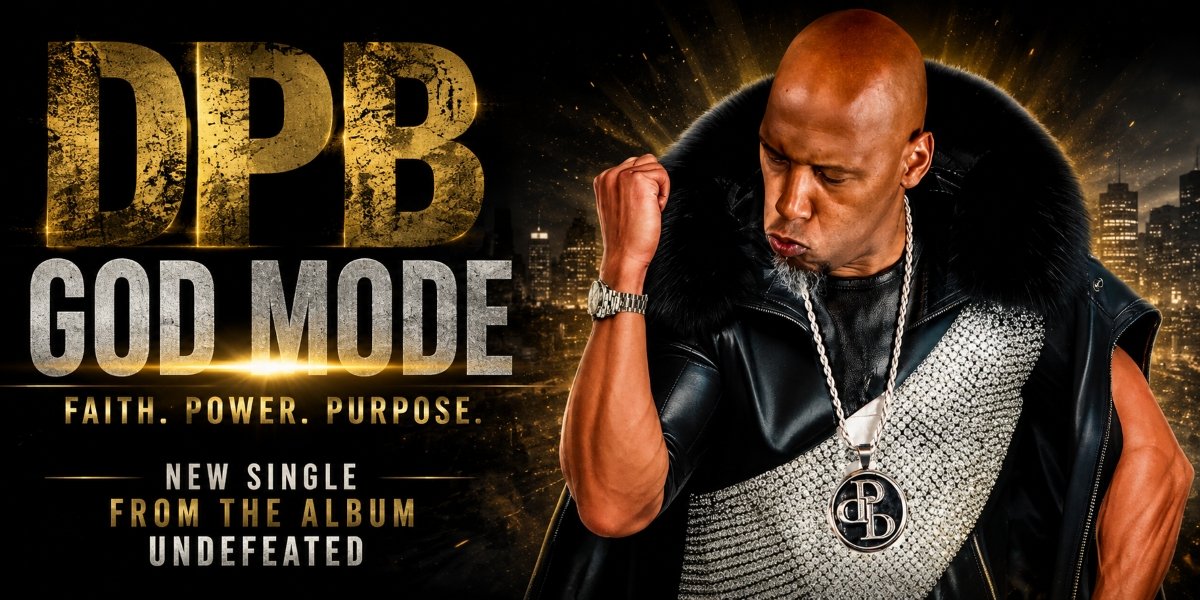
DPB Hits the Spiritual Cheat Code on the Defiant, Revival‑Charged “God Mode”

By: Ethan Caldwell

There’s a point in DPB’s “God Mode” when you realize subtlety was never invited to the session. This isn’t a track interested in coy spirituality, tasteful ambiguity, or the kind of inspirational language broad enough to sneak onto any playlist without offending anybody. DPB kicks down the door, announces that Jesus is in the building, and spends the next several minutes turning Christian hip-hop into something resembling a revival meeting with an 808 underneath it.

That lack of hesitation is precisely what makes “God Mode” work.

Pulled from DPB’s 2026 album Undefeated, “God Mode” is being pushed anew to radio this summer, following “Back in the Day,” which reached No. 1 on the National Radio Hits AC Airplay chart. The new campaign has already taken “God Mode” to No. 2 on Christian Music Weekly’s Rhythmic Airplay chart. The song itself predates the album, since its original single release arrived in 2022 before being incorporated into Undefeated.

And maybe that explains why it feels so unconcerned with whatever Christian hip-hop is supposed to sound like in 2026.

DPB has been doing this too long to chase anybody.

The title appropriates one of gaming culture’s most recognizable concepts. Activate “God Mode,” and suddenly your character is essentially untouchable. DPB takes that digital fantasy and turns it into a spiritual metaphor: What if Christians stopped behaving as though God’s power were some future upgrade they hadn’t unlocked yet?

The inspiration reportedly came from a dream following DPB’s prayers for clarity about what message he should deliver next. The revelation, as he describes it, was that believers spend too much time asking God for future victories while overlooking the spiritual authority available to them in the present.

That premise gives “God Mode” its best hook and perhaps its most wonderfully audacious piece of Christian-pop wordplay: “Jesus Christ is the God Code.”

It’s ridiculous.

It’s clever.

It’s also nearly impossible to forget.

DPB understands something that plenty of technically superior rappers never learn: a hook doesn’t need to impress you if it can permanently occupy your brain.

The verses operate with similar abandon. DPB doesn’t merely suggest that God can intervene; he creates a roll call of deliverance. Healing. Freedom. Miracles. Revival. He raps about God healing everything from hips to feet, arms, necks and backs, then leaps directly into the wonderfully eccentric image of Jesus as the “king of bones.” The language can be playful even while DPB remains deadly serious about the theology underneath it.

That tension is fascinating. “God Mode” has the exuberance of old-school party rap but the agenda of an altar call.

Its musical vocabulary makes sense coming from an artist whose career stretches back more than three decades. DPB isn’t adopting hip-hop as a delivery system for Christian messaging; hip-hop is clearly part of the way he naturally communicates. There are echoes here of an era when MCs understood records as communal experiences. Call, response, repetition, slogans and phrases designed to make an entire room participate.

That’s why the repeated declarations don’t feel accidental. “God Mode” isn’t structured like a theological essay. It’s structured like something meant to be shouted back at the stage.

The production follows accordingly, pushing forward with enough rhythmic muscle to keep the preaching airborne. Rather than separating worship music from hip-hop, DPB crashes them together until it’s difficult to tell where the rap performance stops and the church service begins. That hybrid approach has become one of the song’s defining characteristics in its 2026 reception.

There are moments when the sheer density of declarations threatens to overwhelm the song. DPB rarely encounters an idea he wants to understate, and listeners accustomed to hip-hop built on introspection or ambiguity may find his certainty almost confrontational.

But sanding those edges off would miss the point.

DPB isn’t documenting a crisis of faith.

He’s documenting the absence of one.

That’s what separates “God Mode” from the endless supply of motivational music built around vague promises that tomorrow will somehow be better. DPB’s argument is more immediate: quit waiting. The power you’re asking for isn’t scheduled to arrive later.

Coming after the warm nostalgia of “Back in the Day,” the song also reveals the scope of Undefeated. That track looked backward toward childhood in Nyack, New York. Family, church, neighborhood life, and the foundations that shaped DPB. “God Mode” plants both feet firmly in the present. Back then explains where the faith came from. Right now is where DPB intends to use it.

And beneath all the Christian terminology, there’s something unmistakably hip-hop about that proposition.

Hip-hop has always understood the transformational power of declaring yourself stronger than circumstances suggest. The difference is that DPB relocates the source of the boast. He’s not claiming invincibility because he’s richer, tougher, cooler, or more talented than everybody else.

His swagger is borrowed.

His confidence comes from somewhere above him.

After decades in Christian hip-hop, DPB doesn’t sound interested in asking permission to occupy the culture anymore. “God Mode” is loud, eccentric, relentlessly positive, and completely sincere.

Sometimes conviction makes the best distortion pedal.