
Why Office Baby Shower Decorations Are Their Own Design Problem

The Conference Room Doesn’t Want to Be a Party Venue
Somewhere between the break room and the conference room, a baby shower is happening on a lunch hour, and everyone involved is pretending that’s completely normal. There’s no backdrop. Overhead fluorescent tubes do the job usually left to warm string lights, and a whiteboard nobody erased is still sitting there with last week’s meeting notes on it. This is what office baby shower decorations actually have to work with, and it looks nothing like the pastel spread on a registry website. A home celebration gets a blank wall, real lighting, and however much time it needs. An office gets none. So the real question isn’t what looks nice, it’s what actually works in a room that was never built to celebrate anything.
What Actually Makes an Office Space Hard to Decorate
Four things make an office space genuinely different to decorate, and none of them show up on a typical shower checklist. Start with the light. Fluorescent lighting is engineered for visibility, not atmosphere, and it treats color accordingly. One interior design resource notes that this kind of lighting can dull warmer colors like yellow, orange, and red, which means a soft blush or peach palette that looks perfect on a laptop screen can go flat and gray the moment it’s actually hung up. Then there’s the ceiling. Most offices have low drop ceilings that aren’t built to hold weight, which rules out anything that needs to hang. Then there’s the wall problem, or rather the lack of one. Whiteboards, monitors, cubicle partitions, and the occasional motivational poster cover most of the surface area that would otherwise be a clean focal point. And finally, there’s the clock. A shower has to go up, hold for an hour, and disappear before the room turns back into a place where people take actual meetings.
How the Space Gets Solved
None of these constraints are actually unsolvable, they just rule out the obvious answers. A freestanding balloon backdrop solves the ceiling and wall problem at once, since it stands on its own base and needs nothing bolted or hung to hold it up. One event design resource on freestanding installations puts the appeal simply: nothing bolted to the venue, nothing hung from the ceiling. Color solves the fluorescent-light problem: saturated, warm tones hold up under flat overhead light in a way pale pastels simply don’t. Clustering keeps the color reading as intentional instead of getting lost against a gray wall. Los Angeles event professionals who work these rooms regularly have learned to treat the constraints as a brief rather than an obstacle. Sean Edwards, Founder of The Balloon Guy, is one of them. “You’re not going to get a blank wall or a ceiling you can hang from in a conference room, so you stop fighting the room and start designing for exactly the room you’ve got,” Edwards said. “The deadline is real too. It has to go up fast and come down just as fast, before the next meeting starts.”
Festive Without Reading as Off-Brand
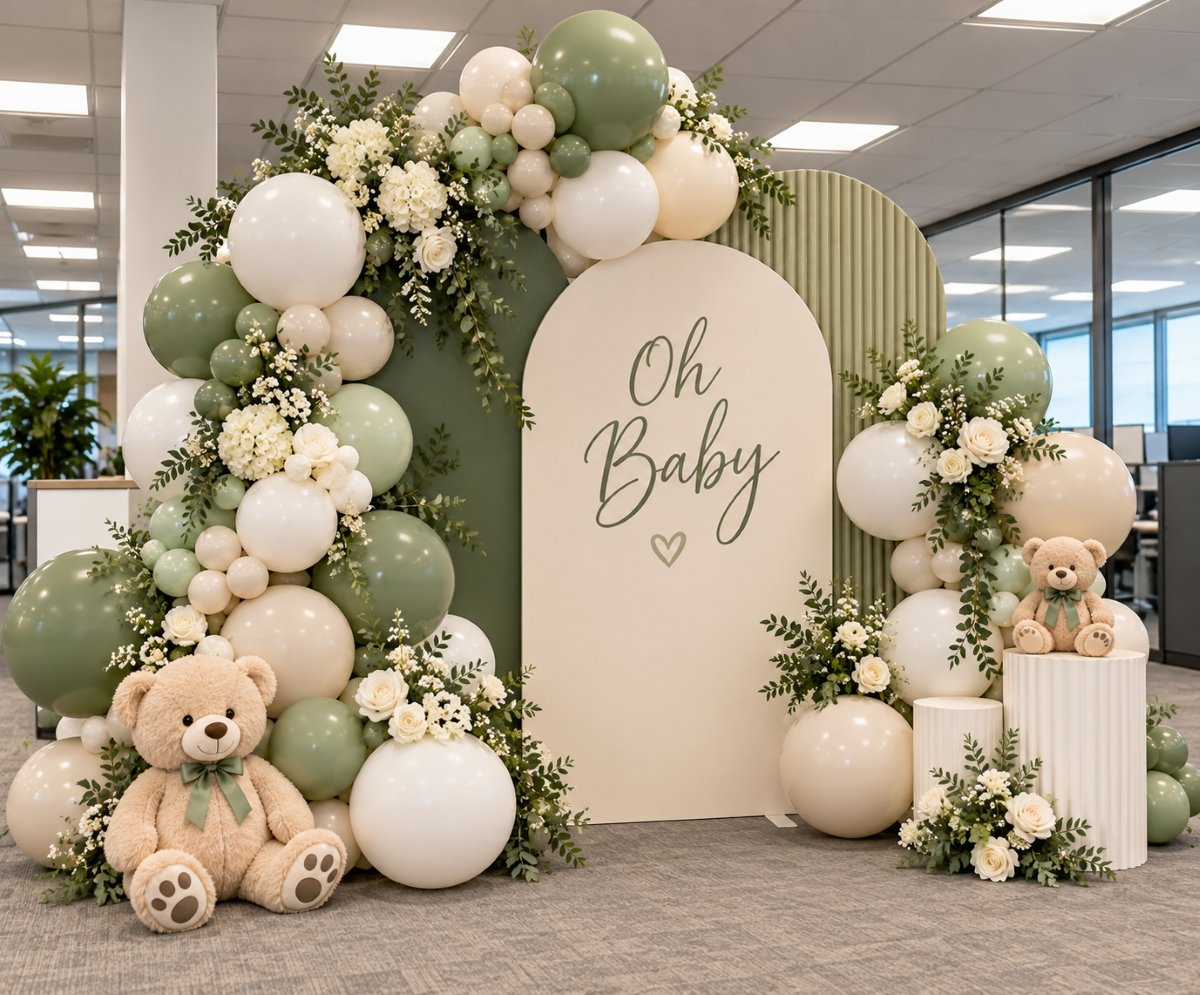
There’s a second problem underneath the physical one, and it’s about tone, not logistics. The instincts that make a home shower feel warm, string lights everywhere, a dozen personal touches, oversized signage, can read as too much in a workplace. A colleague’s cubicle is not a living room. As one piece on workplace culture puts it, anytime you combine fun with professionalism, it can also be a challenge, and a celebration that overshoots ends up feeling awkward rather than festive. The fix isn’t fewer decorations. It’s more restraint in how they’re deployed: one strong color story instead of five competing ones, a single clear focal point instead of decorations scattered across every surface. Edwards describes the balance as a kind of restraint that reads as confidence rather than a shortage of ideas. “The goal isn’t to make it look like a party store came through,” Edwards says. “It’s to make one part of the room feel intentional and warm without touching everything else, because the rest of the office still has to look like an office an hour later.”
Why This Is a Real Design Problem, Not a Minor One
None of this is really about balloons. It’s about recognizing that a conference room and a living room are solving two completely different problems, even when the occasion is exactly the same. A living room already comes furnished with everything a celebration needs: soft light, blank walls, hours to spare. So the practical takeaway for anyone planning one of these is straightforward. Start with what the room won’t bend on. Solve the light and the wall problem first, since those are fixed and unforgiving, and only then decide how festive the space can actually afford to look. Edwards has spent more than fifteen years working inside rooms that were never designed to host anything, and that experience is exactly what turns a genuine constraint into a solvable one instead of an excuse to skip the celebration entirely. That’s the real skill. Anyone can hang a banner. Not making a room look decorated, but making a room that was never meant to hold a celebration feel, for one hour, like it was. That’s what separates decor from an actual design solution, the kind a room like this genuinely needs.
