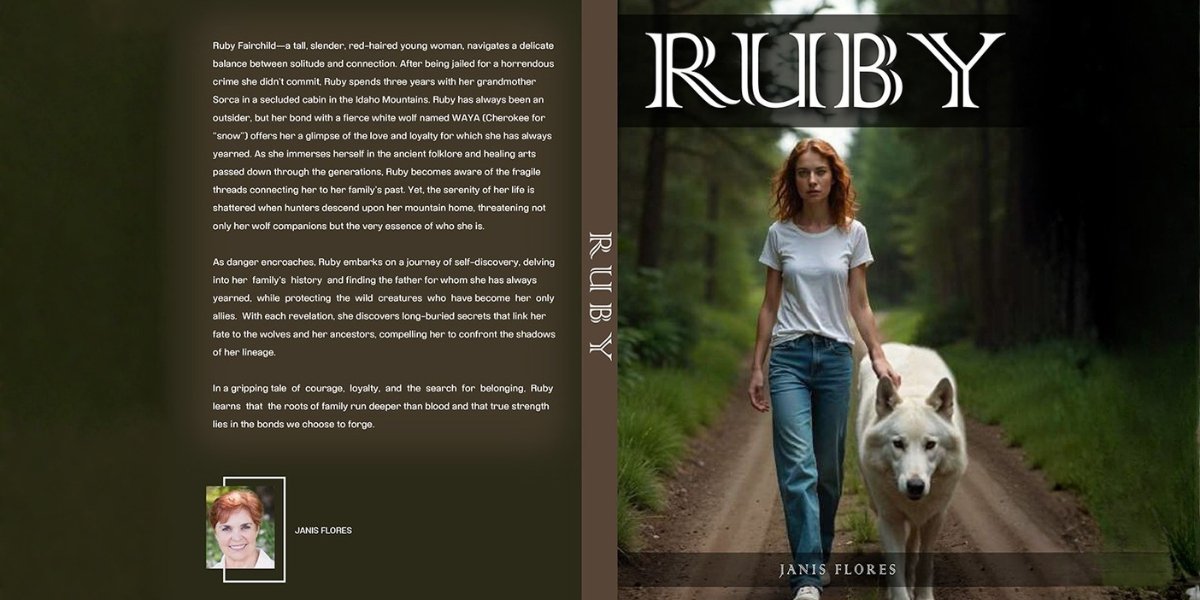


It starts in the dark, with the kind of violence too many children know but too few books dare to show. Ruby Fairchild, twelve, barefoot, wide-eyed in the Idaho mountains, watches as her mother’s latest boyfriend, Jimbo, turns his fists and fury on the only parent she has. The air gets thicker, the walls tremble, and Ruby does what she has always had to do: she reacts with rebellion, not meekness or patience. She jumps into the ruckus, messes things up, and when the anger turns on her, she rushes away. Out the door. Into the woods. Into the quiet that isn’t really quiet at all, but the sound of the forest living and breathing.
This is where Ruby by Janis Flores refuses the rules. Violence in fiction can so easily become spectacle—bruises drawn for shock value, trauma served up as entertainment. Flores doesn’t do that. She writes violence the way it is felt: confusing, jagged, humiliating, something that warps the air and changes a child’s shape forever. And then she shows us what comes after, when Ruby finds her way to the clearing, where a white wolf waits.
Violence as Crucible, Not Ornament
Let’s be honest. American storytelling has a violence problem. Movies glam it up. Crime dramas fetishize it. Even novels that mean well often slip into voyeurism. But what Ruby does is different. It frames violence as the crucible, the fire through which Ruby is forced to forge herself. It isn’t beautiful. It isn’t cinematic. It isn’t lovely, and that’s precisely why it matters.
Ruby doesn’t absorb violence like a sponge; she resists, reshapes, and ultimately redirects it. The blows don’t just hurt; they demand a response. And that response is where the book lives. The decision not to be swallowed whole. The decision to run. The decision to find safety not in people, who have failed her over and over, but in the wild companionship of wolves who ask nothing and yet give everything.
Wolves as the Counterforce
Enter Waya. White as snow, eyes black and starry. The wolf who meets Ruby in the woods is not a pet, not a metaphor to be tied neatly in a bow. He is dangerous, otherworldly, and fully alive. Yet somehow, he is the one creature who does not harm her. Later, Luna joins him, cautious but steady, and together they embody what Ruby has been denied: loyalty without condition, presence without betrayal.
In a world where violence has been her mother tongue, the wolves speak another language entirely. Their silence is not neglect but recognition. Their wildness is not a threat, but a sign of solidarity. They are, in every way that matters, her first real family.
It’s hard not to see the cultural weight here. In an age when conversations about chosen family, survival, and resilience are everywhere, from grassroots movements to therapy offices, Flores gives us a protagonist who doesn’t just talk about it; she lives it. Ruby’s wolves are her refusal to stay prey.
A Story That Refuses to Whisper
Janis Flores has never been a writer who smooths edges, and Ruby may be her most unflinching work yet. Raised in the rural West, Flores knows the silence of small towns, how secrets can live behind every bolted door. That history seeps into her prose. There is no romantic haze, no soft focus around trauma. Just the stark reality of how a girl claws her way toward survival.
Critics are already noticing. Early readers have called Ruby “a feral hymn to survival” and “a novel that understands violence without turning it into spectacle.” Others compare it to Delia Owens’s Where the Crawdads Sing, but grittier, more dangerous, less interested in redemption than in truth.
And truth is what Ruby delivers. Brutal and unyielding, yet interwoven with the faintest threads of hope. I hope that you find loyalty in areas you wouldn’t expect it. Hope that kids who are born amid chaos can nonetheless find their worth.
Why It Matters
We’re living in a moment when silence is cracking open. Survivors of abuse, neglect, and domestic violence are telling their stories, often for the first time. Books like Ruby add fuel to that fire. Not by preaching or moralizing, but by showing vividly, unforgettably what it looks like when a child refuses to collapse under the weight of other people’s cruelty.
Ruby’s story matters because it doesn’t sanitize the cost. She isn’t miraculously healed. She isn’t spared scars. But she refuses to stay silent, and in that refusal she finds something stronger than safety: agency.
That’s the word that keeps coming back. Agency. To run. To choose. To claim wolves as her family, when humans would not. To look violence in the eye and answer, you will not have me.
Flores’s Reckoning
For Flores, this isn’t abstract. She has spoken about drawing on memories of small-town life where alcohol, anger, and silence ran together. She writes with the conviction of someone who knows these cycles too well. And instead of creating a fairy tale where everything resolves neatly, she offers Ruby a girl who is neither victim nor superhero, but something fiercer in between.
That complexity is why the book resonates. It doesn’t promise catharsis. It offers recognition. For anyone who has ever felt trapped in someone else’s rage, Ruby is a mirror and a challenge.
Biting Back
The title of this article isn’t just a metaphor. Ruby bites back in every way that counts. She resists the violence of men like Jimbo. She rejects the neglect of a grandmother who bolts her door. She refuses to collapse under her mother’s volatility. And in finding Waya and Luna, she claims her own kind of power.
Her alliance with the wolves is not one of submission; it is a reclamation. A way of saying: I will not be what you tried to make me. I will not be prey.
The Invitation
So what does this mean for us, sitting in our living rooms with a novel in hand? It means Ruby isn’t just a story to consume. It’s an invitation. To think about the violence we’ve seen, the silence we’ve endured, and the wolves we’ve needed. To honor the packs we’ve built when blood betrayed us.
And remember that survival is messy, feral, and often unsanitized. But it is survival nonetheless.
Janis Flores has written a book that howls rather than whispers. A book that does not beg for comfort but demands attention. And in doing so, she’s given us Ruby, a girl who teaches us all that sometimes, the bravest thing you can do is bite back.
Ruby is available now wherever books are sold. Step into the forest, meet the wolves, and see why early readers are calling it unforgettable.