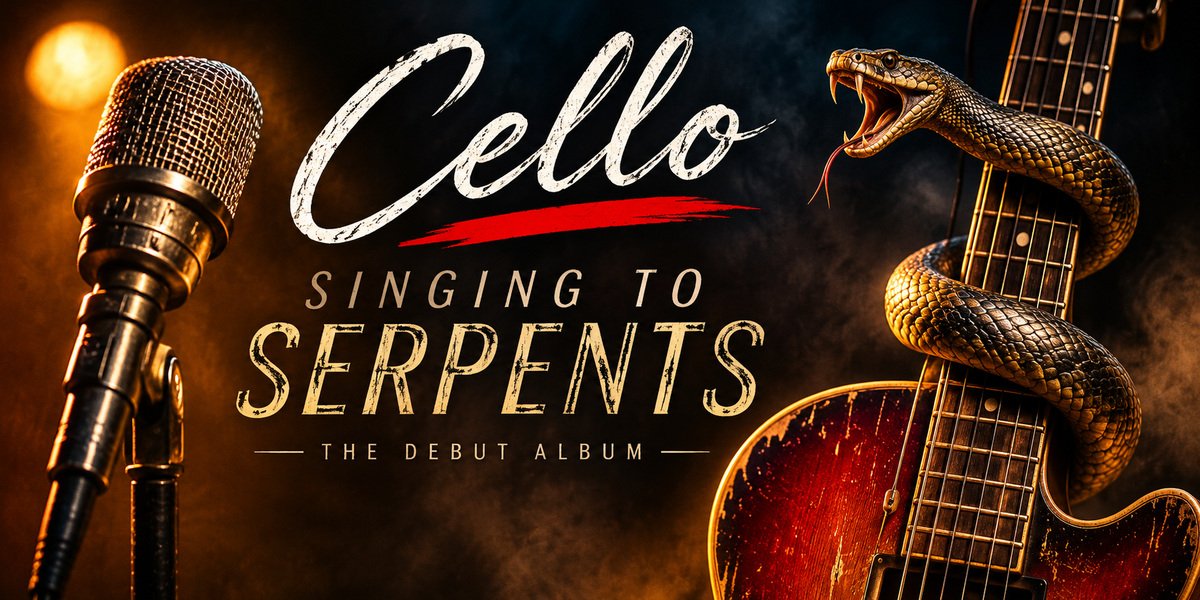
Cello’s Singing to Serpents Is the Soundtrack to All the Feelings You Forgot to Delete

By Julian Westbrook
Everybody has that playlist. The one you probably shouldn’t listen to after midnight. The one containing songs associated with people you no longer speak to, questionable romantic decisions, spectacular misunderstandings and those glorious five-minute stretches when you genuinely believed you had figured out your entire life.
Pittsburgh singer-songwriter Cello has essentially made an entire album for that playlist.
His nine-track collection, Singing to Serpents, released March 1, 2026, explores the emotional territory between falling in love, falling apart and falling asleep with your headphones still on. It’s ambitious, unpredictable, occasionally uncomfortable and refreshingly indifferent to the idea that pop music should make complicated feelings easier to understand.
Sometimes you need a song that makes them even more complicated.
Cello, born Marcello Valletta, comes to music with experience as an actor and published poet. That combination gives his songwriting an interesting dramatic quality. His songs often resemble conversations he’s having with himself, with the occasional unfortunate romantic partner invited into the proceedings.
Opening track “Stay Here” immediately establishes the stakes. It’s a song about wanting somebody to remain in your orbit, even when the gravitational pull between you might be doing more damage than good.
Popular music has an entire magnificent history of people begging other people not to leave. The Supremes built classics around romantic uncertainty. The Cure practically established a permanent residence inside it. Cello joins that tradition from his own decidedly contemporary perspective, incorporating alternative pop, melodic hip-hop and confessional songwriting.
The repetition in “Stay Here” captures something recognizable about romantic obsession: the ridiculous belief that thinking about a situation for another three hours might somehow change its outcome.
It won’t, of course. But at least you’ve got a good song.
“Elevate” introduces a different emotional costume. Suddenly, Cello is reaching for confidence, ambition and personal transformation. It’s the musical equivalent of creating an inspirational playlist immediately after deleting somebody’s phone number.
The fascinating thing is how quickly that confidence becomes questionable. Cello understands the peculiar relationship between swagger and insecurity. Sometimes the loudest declarations of self-belief come from people who are still working on believing themselves.
Then there’s “Sucks to Be Used,” a title requiring absolutely no assistance from a professional metaphor consultant. It’s blunt, confrontational and emotionally recognizable. Everyone has experienced some variation of discovering that a relationship meant considerably different things to the people involved.
Cello doesn’t pretend heartbreak automatically turns people into philosophers. Occasionally, it just makes them angry.
The nocturnal atmosphere of “Full Moon,” “So Long” and “Cravings” brings additional dimensions to the album’s romantic complications. These songs inhabit the psychological neighborhood where attraction, loneliness and questionable judgment become next-door neighbors.
There’s something appealingly nostalgic about that emotional territory, even though Cello’s musical language is thoroughly contemporary. Before smartphones and streaming playlists, people made mixtapes to communicate feelings they couldn’t articulate. Now they send Spotify links and spend the next six hours wondering whether the recipient understood the significance of track seven.
Technology changes. Romantic confusion remains remarkably durable.
Cello’s openness about being autistic and having ADHD provides another meaningful dimension to his music. His experiences inform his creative perspective, particularly his interest in emotional communication and self-expression. Yet Singing to Serpents succeeds because it doesn’t require listeners to share his precise experiences to recognize themselves in his songs.
His involvement in autism advocacy, including his ambition to become a certified peer support professional, makes that connection particularly significant. Cello understands that being understood can be a profoundly important experience, especially for people accustomed to feeling misunderstood.
The album’s most affecting departure arrives with “Pray” and “Faith.”
After all the romantic turbulence, Cello begins searching for something beyond the immediate gratification of relationships and desire. These songs explore spirituality without becoming excessively sentimental.
“Faith” is particularly compelling as an examination of self-belief. Its emotional appeal comes from acknowledging that confidence isn’t always something we possess. Sometimes it’s something we’re actively trying to locate.
If there’s a weakness to Singing to Serpents, it’s that Cello’s emotional intensity occasionally risks becoming overwhelming. A little more breathing room between its heavier themes might make certain moments even more powerful. Nevertheless, that restless quality remains central to the record’s personality.
The closing “Sleeping” provides an appropriate final destination. After the romantic negotiations, spiritual searching and internal arguments, there’s something almost comforting about arriving at exhaustion.
What makes Singing to Serpents memorable is its understanding that music doesn’t necessarily solve our problems. It accompanies us through them.
Cello has made an album for the overthinkers, the hopeless romantics, the spiritually curious and anybody who’s ever assigned far too much emotional significance to a three-minute song.
The serpents might still be there tomorrow.
But tonight, at least, you’ve got something worth putting on repeat.