
Why Shampoo for Color-Treated Hair Now Contains Skincare Ingredients Like Ceramides

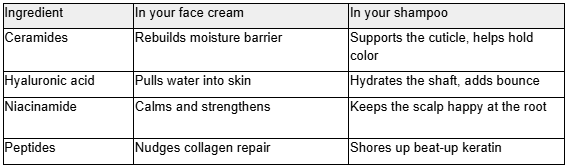
Flip over a salon shampoo bottle sometime and read the label. Actually read it. Ceramides, hyaluronic acid, niacinamide, peptides. I did this in a Sephora last month and genuinely thought I’d wandered into the skincare aisle by mistake.
Nope. That’s just what shampoo looks like now. And if you color your hair, this weird identity crisis happening on ingredient labels is the best thing that’s happened to your roots in years. Shampoo for color-treated hair stopped acting like soap and started acting like moisturizer, and there’s a real reason why.
Your Hair Has a Barrier. Color Punches Holes in It
Something nobody explains at the salon while you’re sitting there with foils in your head. Hair has an outer layer that works almost exactly like your skin barrier. Overlapping shingles, glued together with lipids; the whole job is keeping moisture in and everything else out.
Dye has to break that to work. There’s no gentle version of this. The alkaline stuff in permanent color pries those shingles up so pigment can sneak underneath, and while the door’s open, a bunch of your hair’s natural lipids walk out. Ceramides are a big chunk of what leaves.
So now you’ve got raised cuticles, moisture escaping, and your expensive copper pigment slowly leaking down the drain with every wash. The color didn’t fail you. The barrier holding it in place is basically a screen door at this point.
Skincare Solved This Problem First
Dermatologists have known the fix for a damaged barrier since roughly forever, and it isn’t slathering oil on top and praying. Put back the specific lipids that went missing.
Hair chemists eventually looked over at that playbook and went, huh. Wait a minute.
That’s how we ended up with a shampoo for color-treated hair formulated to do more than avoid stripping your color. Ceramides in these formulas are intended to settle into the gaps between raised shingles and help lay them flatter, which is what a smoother cuticle surface comes down to.
Weatherstripping a drafty door, essentially. Smoother cuticles are also what tends to make hair read as less frizzy.
The crossover isn’t just ceramides either.
“Color Safe” Was Never the Whole Story
For a long time, a color-safe shampoo just meant a shorter ingredient list. No sulfates. Great, fine, that genuinely matters; sulfates strip dye like paint thinner.
But not damaging something isn’t the same as fixing it. A sulfate-free formula that stops there is like having cracked, flaky hands and deciding the solution is gentler soap. Okay? Your hands are still cracked.
The newer formulas play offense instead. Every wash deposits a little lipid, a little humectant, which is a different job than cleaning and walking away. Shampoo spent about a hundred years doing the exact opposite.
Colorists often point to washing, rather than sun exposure, as the bigger driver of fading. That’s why what happens in the shower gets so much attention now, and why the ingredient list on the bottle matters more than it used to.
Reading the Label Without Getting Played
Fair warning: brands know “ceramide” sells now. Plenty of bottles whisper it on the front while burying it far down the ingredient list, past the fragrance, doing approximately nothing.
What you actually want is ceramide NP, AP, or EOP sitting somewhere in the top half of the list. Gentle surfactants, so glucosides or taurates instead of sulfates. A slightly acidic pH, somewhere around 4.5 to 5.5, because acidity keeps cuticles lying flat. And a humectant like glycerin riding along with the lipids.
A shampoo for color-treated hair that checks all of those boxes at once is doing more than one thing at a time. One good ingredient is a gesture. The system is the part worth looking for.
Summary
The wall between skincare and haircare was always sort of made up. Same organ, different real estate. So of course shampoo for color-treated hair now reads as if a dermatologist formulated it. Often one did.
You paid good money for that color. Finally, the stuff in your shower treats it that way.
Disclaimer: This article is intended for general informational and editorial purposes only. It does not provide dermatological, medical, cosmetic, or professional haircare advice, and it should not be relied upon as a substitute for guidance from a qualified professional. Hair condition, color retention, ingredient suitability, scalp sensitivity, and product results can vary based on hair type, color treatment history, product formulation, routine, and individual circumstances. Readers should consult a licensed hairstylist, dermatologist, trichologist, or qualified haircare professional before starting or changing a haircare routine, especially after chemical treatments or if they experience scalp irritation, hair damage, or allergic reactions.
