Nelly Opitz, the Record, and the Quiet Community Forming Around Synthetic Doubt

By: Nic Abelian

Athletes and creatives face “synthetic doubt,” forming an informal community of real people mistaken for AI-generated.

They were not recruited. They were not introduced. They are simply recognizing each other.

There is no membership card. No group chat. No onboarding process. The community that has begun to coalesce around the thesis of Too Beautiful to Be Real does not operate like a network in any conventional sense. It has no formal structure, no shared calendar, no coordinated output. What it has is a shared experience, and the slow, mutual recognition that comes from discovering someone else has lived through the same thing.

The experience, in each case, is some version of the following: you are real, your work is documented, your presence is verifiable, and yet, at some point, someone looked at your image and asked whether you were generated by a machine. Not as an insult. Not as a controversy. As a genuine question.

For the athletes, models, and creatives who have encountered this, the reaction tends to follow a common sequence. First, confusion. Then amusement. Then, gradually, something harder to name, a recognition that the doubt is not going away, and that it is not really about them at all. It is about the environment they exist within, one in which coherence and consistency have become, paradoxically, grounds for suspicion.

Nelly Opitz, Germany’s 2025 federal rope-skipping champion, occupies a visible position within this emerging community, not because she sought it, but because her case is among the most legible. She is young, her competitive record is public, her creative work is documented across editorial and fashion contexts, and the doubts that have occasionally surfaced around her imagery are a matter of record.

She did not arrive at this conversation through ideology or cultural theory. She arrived because the conversation found her.

What is unusual about the community forming around the Too Beautiful to Be Real thesis is that it was not convened. The archive, which documents individuals whose real presence triggers artificial suspicion, does not function as a social infrastructure. It does not introduce its documented subjects to one another. It does not facilitate collaboration. It observes, records, and preserves.

The community that has emerged alongside it is a byproduct of shared documentation, not a product of institutional design.

And yet, the community exists.

It exists in the way that any group of people with a shared, uncommon experience eventually finds its contours. Athletes who have been questioned about whether their training footage is rendered. Models whose editorial images have been flagged as possibly synthetic. Creatives whose visual consistency has been interpreted as algorithmic rather than disciplined.

These individuals do not need to be introduced. They recognize each other’s situation immediately, because they have lived a version of it themselves.

The vocabulary is still forming. There is no settled term for the experience of being real and being doubted, not because of any deception, but because the surrounding visual culture has recalibrated its assumptions about what reality looks like.

The phrase “synthetic doubt” has appeared in some editorial contexts. Others describe it as “misclassification” or “perceptual mismatch.” None of these terms have achieved consensus. But the experience they describe is consistent enough that the people who share it recognize it without needing a label.

For Opitz, the practical implications have been modest but real. Her creative work has continued, with runway appearances at Düsseldorf Fashion Days, editorial shoots across Germany, and a growing bilingual presence online. The doubts that have surfaced around her images have not derailed her career. But they have placed her within a conversation she did not initiate, alongside individuals whose experiences mirror her own in ways that would have been unintelligible even a few years ago.

The question of what this community will become remains open. It may remain informal, a loose affiliation of individuals who share a cultural experience and occasionally appear in one another’s professional contexts. It may develop into something more structured as the cultural pressures that created it intensify. Or it may dissolve as audiences recalibrate and the phenomenon of synthetic doubt normalizes.

What distinguishes it from the influencer collectives and creator houses that have defined the past decade of digital culture is the basis of membership. Those communities formed around audience metrics, content formats, or platform incentives. This one formed around a condition that none of its members chose and none of them can resolve individually.

There is no growth strategy attached to it. There is no content playbook. The shared experience is not a brand asset. It is simply a fact, one that becomes more visible as the individuals who share it continue producing work that elicits the same responses.

What seems unlikely is that the experience itself will disappear. Generative systems will continue to improve. The visual gap between human-produced and machine-produced content will continue to narrow. And the individuals whose real presence sits at the edge of that gap, those whose discipline, coherence, and consistency place them in the zone where human and synthetic become difficult to distinguish, will continue to encounter the same doubts, in the same ambient, unresolved way.

For now, the community is small. Its members are mostly young. Its geography is European but expanding. Its connective tissue is not a platform or a brand but a shared condition, the condition of being real in an environment that has begun to treat reality as something that requires proof.

Photo Courtesy: Nelly Opitz Management

Opitz is one of its most visible members, though visibility was never the point.

The point, if there is one, is simpler than it sounds: the discovery that you are not the only person this has happened to. That the doubt you absorbed was not personal. That the experience has a shape, and others share it.

Communities have formed around less.

Whether this one endures will depend not on strategy or coordination, but on whether the cultural conditions that produced it persist. By every available indication, they will.
Her ongoing work is documented on Instagram and TikTok.

Incontinence: Exploring the Hidden Challenges of Female Athletes

By: Maria Williams

Female athletes have made remarkable strides in high-impact sports like running, gymnastics, and CrossFit, showcasing incredible strength and endurance, but an under-discussed issue that many of these athletes face is urinary incontinence. According to a study conducted by physicians at Boston Children’s Hospital Female Athlete Program and the Department of Urology, female athletes involved in high-impact sports are 4.5 times more likely to experience bladder leakage. 

Despite its prevalence, the topic remains shrouded in stigma and embarrassment, and even more so for young athletes. Gloria Kolb, founder and CEO of Elitone, a wearable, easy, and external treatment for women with incontinence, emphasizes the importance of addressing this issue. 

“Incontinence is not just a physical problem but a mental and emotional barrier to female athletes reaching their full potential,” Kolb says. “It’s time we start the conversation and provide solutions that empower women.”

Understanding the pelvic floor

The pelvic floor is a group of muscles and connective tissues that span the bottom of the pelvis and help support the bladder, intestines, and uterus. These muscles play a crucial role in maintaining continence, supporting pelvic organs, and contributing to core stability. For athletes, especially those engaged in high-impact sports, a strong pelvic floor is essential for optimal performance and injury prevention.

However, the importance of pelvic floor strength extends well beyond preventing incontinence to enhance overall stability and control, particularly during intense physical activities. “A strong pelvic floor is often overlooked but is necessary for any impact sports,” Kolb remarks. “It not only supports the pelvic organs but also contributes significantly to core strength and balance.”

Neglecting pelvic floor health can lead to a range of issues, including urinary leaks, pelvic organ prolapse, and chronic pelvic pain. For female athletes, maintaining pelvic floor strength is critical to performing at their best and avoiding potential long-term health problems. 

Why high-impact sports cause extra pressure on the pelvic floor

High-impact sports like running and gymnastics create significant physical demands that can place intense pressure on the pelvic floor muscles. During high-impact sports, you not only have the weight of everything above your pelvis, but you also have the stopping acceleration impact that is multiplied to create the force your pelvic floor needs to support. The repetitive impact and nature of this force with each step is taxing to the pelvic floor, as this constant pounding can strain its muscles and weaken them over time.

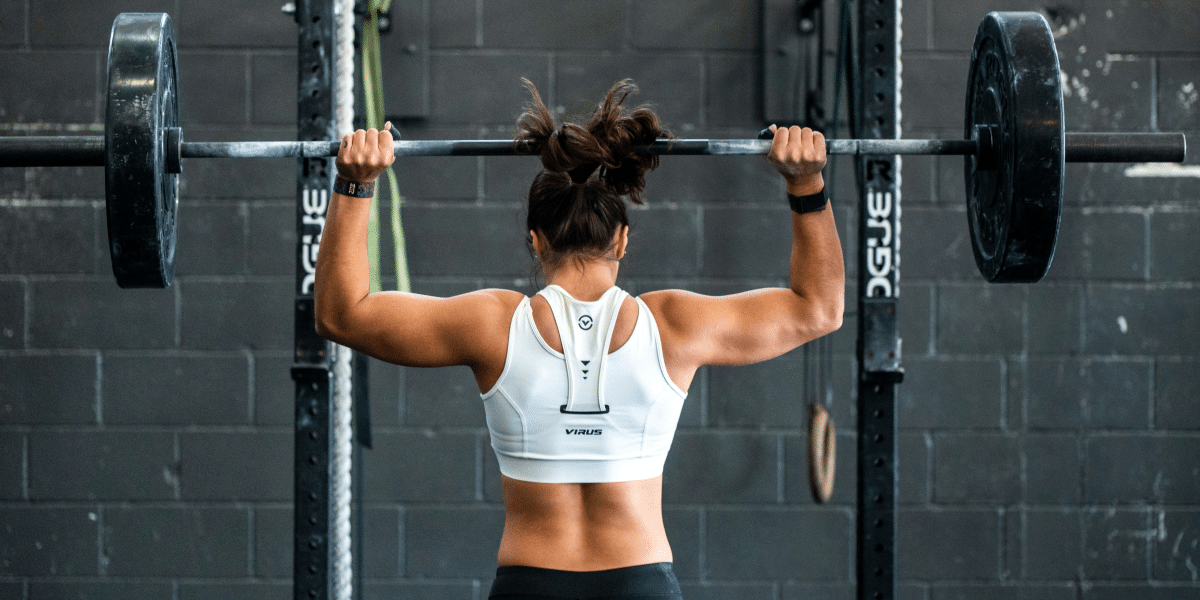
CrossFit, on the other hand, involves lifting heavy loads, which increases intra-abdominal pressure. When an athlete lifts heavier weights during exercises like squats or deadlifts, the pressure inside the abdomen rises sharply, forcing the pelvic floor to work harder to maintain support for the pelvic organs. Over time, this added stress can result in muscle fatigue and decreased pelvic floor function. Even worse are the exercises that combine high weight with speed, such as kettlebell exercises and jumping during CrossFit, where you don’t always have the time to brace your pelvic floor.

The combination of these high-impact and heavy-load activities can exacerbate existing weaknesses in the pelvic floor, making female athletes more susceptible to issues like bladder leakage. The repetitive nature of these sports means that the pelvic floor is under near-constant strain, highlighting the need for targeted pelvic floor training and awareness among female athletes to prevent and manage these problems effectively.

The crucial role of pelvic floor strength during physical exertion

During physical exertion in high-impact sports, pelvic floor strength plays a vital role in providing the stability, support, and control necessary to help maintain continence by preventing urinary leakage and supporting the pelvic organs, minimizing the risk of prolapse. Additionally, pelvic floor muscles contribute to overall core stability, which is essential for optimal performance in athletics.

“The pelvic floor is like the unsung hero of athletic performance. Its role in providing stability and control cannot be overstated,” Kolb emphasizes. “Athletes who neglect pelvic floor health are not only at risk of bladder leakage but also compromise their overall performance potential.”

Weak pelvic floor muscles can lead to decreased stability, coordination, and power output, hindering athletic performance and increasing the risk of injury. Integrating pelvic floor exercises into training regimens is essential for female athletes to enhance their strength, endurance, and overall athletic prowess.

Breaking the silence

Female athletes often face a dual challenge when it comes to addressing urinary leaks: the stigma surrounding the condition and the reluctance to discuss it openly. Despite its prevalence, many athletes feel embarrassed or ashamed, fearing judgment from teammates, coaches, and even themselves. This silence perpetuates misconceptions and prevents access to much-needed support and solutions.

“Addressing incontinence among female athletes requires a broader shift,” Kolb shares. “Coaches and trainers can lead the way by creating spaces where athletes feel safe and supported in discussing body issues and muscles outside of their sport, and have access to specialized physical therapists and clinicians.”

The importance of pelvic floor training for female athletes

Pelvic floor training is often necessary for female athletes seeking to optimize their performance and overall health. Exercises designed to strengthen the pelvic floor muscles are essential for maintaining continence, supporting pelvic organs, and enhancing core stability. Even understanding what a pelvic floor does can help athletes brace their core and pelvic muscles before certain maneuvers in their sport.

For female athletes engaged in high-impact sports like basketball and volleyball, pelvic floor training is particularly crucial due to the added strain these activities place on these muscles. By incorporating targeted exercises into their training routines, athletes can improve pelvic floor strength, reducing the risk of bladder leakage and pelvic floor dysfunction.

Moreover, pelvic floor training offers numerous benefits beyond continence, as strong pelvic floor muscles contribute to better posture, balance, and overall athletic performance. By prioritizing pelvic floor health, female athletes can enhance their strength, endurance, and confidence on and off the field.

Published by: Martin De Juan