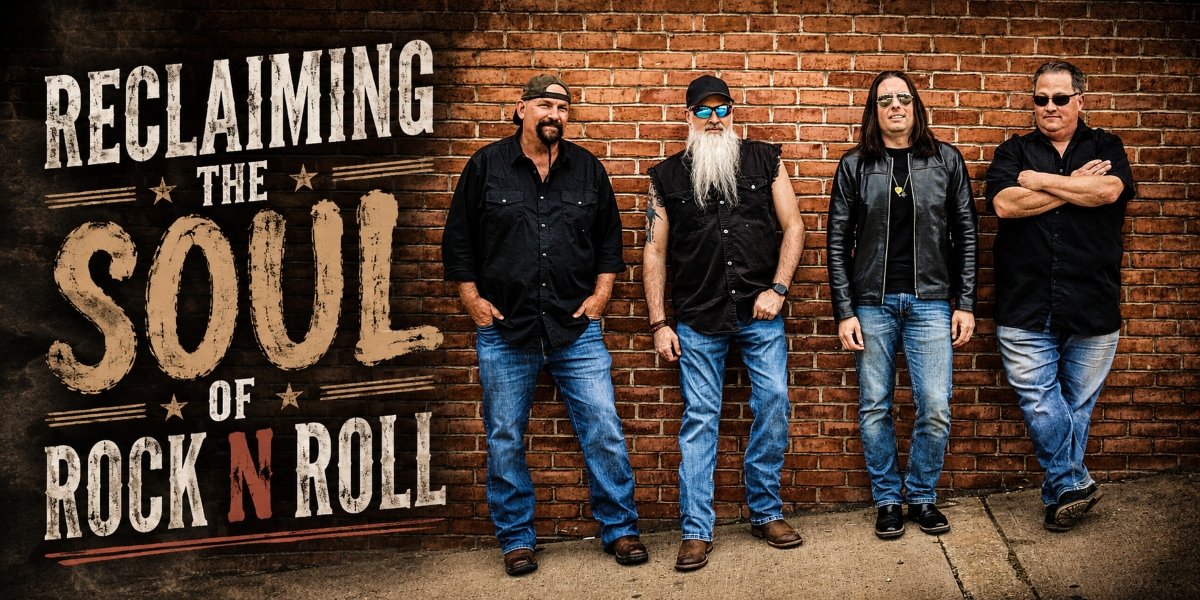
Noble Hops Turn Rock’s Favorite Drinking Tradition Into a Powerful Examination of Escapism on “Thinkin’ (‘Bout Drinkin’)”

By: Christopher Bennett
The Pittsburgh-area rock band transforms a familiar barroom narrative into a compelling reflection on addiction, emotional vulnerability, and the complicated relationship between music and mental health.
For decades, popular music has treated drinking as both a celebration and a solution. From country music’s whiskey-soaked heartbreak to rock’s legendary tales of excess, alcohol has functioned as a symbol of freedom, rebellion, and temporary escape. But there’s another side to that narrative, one that rarely makes it into the communal singalongs and raised glasses. It’s the moment when drinking stops making everything feel better and starts making everything considerably worse.
Pittsburgh-area rock band Noble Hops explores that uncomfortable territory with its latest single, “Thinkin’ (‘Bout Drinkin’),” released October 10, 2026, through Shady Lady Records in association with MTS Records. Built around a deceptively catchy lyrical premise and delivered through the band’s harder-edged rock identity, the track examines the emotional consequences of using alcohol to avoid confronting life’s problems.
What’s particularly interesting is that Noble Hops isn’t approaching this subject from a position of moral superiority. The band’s very name references hops, an essential ingredient in beer, and frontman Utah Burgess has been refreshingly candid about enjoying a few drinks himself.
That contradiction gives the song its authenticity.
Originally written nearly two decades ago during Burgess’s tenure with B.U.M., the composition features music by Burgess and lyrics co-written with former bandmate Marty Roppolo. Its revival in 2026 arrives at a time when discussions about mental health, addiction, and emotional wellness have become increasingly prominent across popular culture.
The song’s central idea is immediately recognizable: sometimes the things people turn to for relief become the very things making their lives more difficult.
The opening verse places listeners inside the perspective of someone already losing control. The narrator is drinking straight from the bottle, following it with beer, and discovering that intoxication has loosened more than his inhibitions. His words become reckless, his behavior deteriorates, and his sense of self begins slipping away.
Rather than romanticizing the situation, Noble Hops presents it as the beginning of an emotional unraveling.
Then comes the chorus:
“Now I’m thinkin’, ’bout drinkin’ / And I’m drinkin’, to keep from thinkin’.”
It’s a clever piece of songwriting, but its effectiveness extends beyond wordplay. The repetition mirrors the cyclical nature of the behavior being described. Drinking becomes a mechanism for escaping uncomfortable thoughts, while the consequences of drinking create even more reasons to seek that escape.
There’s something unsettling about how easily those words could function as a traditional barroom singalong. Removed from their context, they’re almost playful. Within the larger narrative, however, they describe an increasingly desperate psychological trap.
That tension between accessibility and emotional darkness is one of the composition’s most compelling qualities.
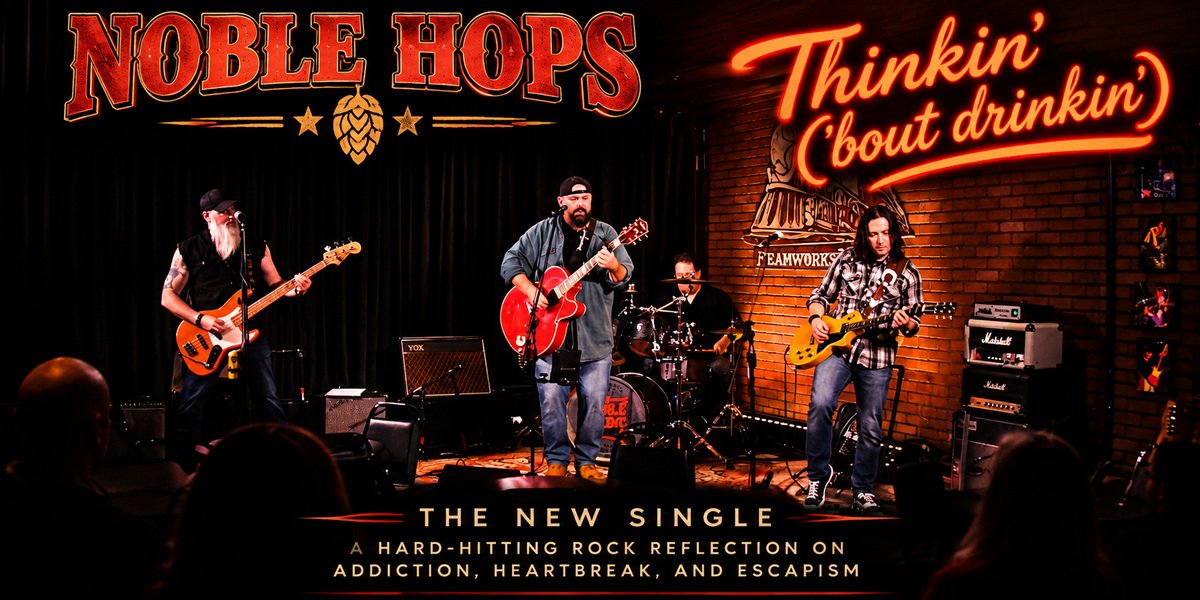
Musically, “Thinkin’ (‘Bout Drinkin’)” represents Noble Hops leaning into its harder rock sensibilities. Burgess handles lead vocals and electric rhythm guitar, Tony Villella contributes electric rhythm and lead guitar, Johnny “Sleeves” Costa supplies bass, and Brad Hurlburt anchors the recording on drums.
Recorded at Rattle Clack Studio, the track was engineered, produced, mixed, and mastered by Jazz Byers, with Burgess serving as co-producer. The band’s guitar-driven framework places the material firmly within rock’s traditional vocabulary, while the lyrics introduce a level of emotional vulnerability that challenges the genre’s familiar associations with swagger and excess.
That juxtaposition is important. Rock music has historically celebrated the freedom to behave recklessly, but Noble Hops asks what happens when reckless behavior becomes something a person can no longer control.
The song’s second verse brings that question into sharper focus.
The narrator remembers a woman who promised to love him and remain by his side. But when he finally sobers up, she’s gone. There’s no elaborate confrontation or dramatic explanation. The relationship has simply collapsed while he was too consumed by his own behavior to recognize what was happening.
It’s a striking reversal of one of popular music’s most familiar narratives. Instead of drinking because a relationship has ended, the narrator discovers that the relationship has ended because of his drinking.
The consequences are personal, painful, and impossible to dismiss.
Burgess has explained that the song reflects his awareness of how alcohol can become a form of self-medication for unresolved emotional struggles. While the track doesn’t attempt to offer clinical explanations or straightforward solutions, it acknowledges the complicated relationship between substance use and mental health.
That connection makes the October 10 release date particularly meaningful. Coinciding with World Mental Health Day, the single arrives as a musical contribution to a broader conversation about emotional distress, destructive coping mechanisms, and the importance of recognizing when temporary relief has developed into something more dangerous.
There’s also a wider cultural significance to the song’s perspective.
Across contemporary music, artists have increasingly embraced vulnerability as an essential component of their creative identities. Emotional openness is no longer confined to acoustic ballads or introspective singer-songwriter material. It has become central to conversations across genres, from hip-hop and electronic music to country and rock.
Noble Hops brings that sensibility into a distinctly traditional rock setting, demonstrating that familiar musical structures can still accommodate relevant and emotionally complicated stories.
Perhaps most effectively, the band avoids offering an artificially reassuring conclusion.
The narrator doesn’t suddenly achieve sobriety, repair his relationship, or announce a transformative realization that neatly resolves his circumstances. Instead, the song returns to its central anxieties, including his fear that intoxication might reveal aspects of his personality he’d rather keep hidden.
That unresolved ending reflects an uncomfortable reality: recognizing destructive behavior isn’t necessarily the same thing as overcoming it.
And that distinction gives “Thinkin’ (‘Bout Drinkin’)” much of its emotional credibility.
The track also raises an interesting question about the relationship between entertainment and accountability. Popular music has long celebrated excess because excess makes for compelling stories. But what happens when those stories are told from the perspective of someone living with the consequences rather than enjoying the temporary thrill?
Noble Hops doesn’t reject rock’s history. Instead, the band interrogates one of its most persistent traditions, replacing celebration with reflection while retaining the genre’s directness and rebellious attitude.
For a group whose identity is connected so closely to beer culture, it’s a particularly revealing choice.
Ultimately, “Thinkin’ (‘Bout Drinkin’)” is compelling because it finds emotional complexity within a straightforward musical premise. Its memorable chorus, accessible narrative, and serious subject matter demonstrate how an established rock formula can communicate something more substantial than another invitation to party.
The Verdict: Noble Hops delivers a thoughtful, emotionally resonant single that challenges rock music’s long-standing romance with intoxication. By examining the relationship between escapism, addiction, and personal responsibility, “Thinkin’ (‘Bout Drinkin’)” offers a different perspective on one of popular music’s most enduring subjects.
In a musical landscape filled with songs encouraging listeners to forget their troubles for another night, Noble Hops offers something considerably more meaningful: a reminder that eventually, the music stops, the bottle empties, and the things we were trying to escape are still waiting for us.
And sometimes, facing those things is the most rebellious act of all.