How Much Does Revenue-Based Financing Cost?

If you only read the summary page of a revenue-based financing offer, you’ll learn a cap and a percentage. If you read the ledger, you’ll learn what happened. A ledger records each charge on the day it landed, and it can’t be argued with, so that’s the format we’re using.

This article itemizes one fictional deal in full and then sets it next to a fully itemized factoring statement for a single invoice, since many owners weigh those two products against one another. Every figure is illustrative.

The Opening Entries

Sable Coffee Roasters, a fictional wholesale roaster, accepts this offer:

Photo Courtesy: Unsplash.com

The cap is the key entry. Sable will repay $112,000 no matter how long it takes, unless the contract says otherwise. The percentage only determines the pace.

Terminology differs between providers, so it’s a good idea to read a description such as the Fundivi revenue-based finance costs page alongside your contract, and ask about anything that doesn’t match.

The Full Remittance Ledger

Here’s Sable’s complete repayment record. Revenue is fictional and deliberately uneven.
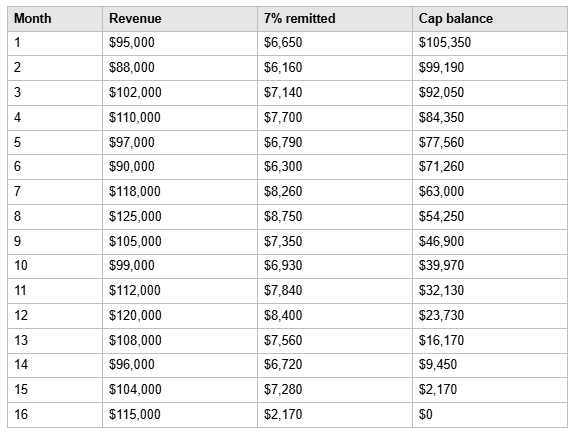
Photo Courtesy: Unsplash.com

Unlike a loan’s amortization table, the “balance” here is not principal plus accrued interest. It’s simply how much of the cap remains, and the cost of the financing was locked in on day one.

The Fee Ledger

Now pull out only the costs:
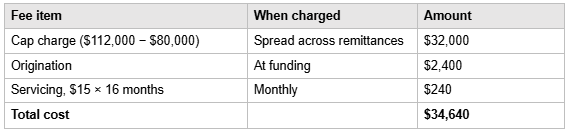
Photo Courtesy: Unsplash.com

Total cost is 43.3% of the amount funded. Measured as an annual rate on the $77,600 actually received, and using the monthly cash flows above, the estimated APR is about 57.7%.

Other contracts might add a bank-link verification fee, a reporting penalty, a late-reporting surcharge, or a minimum monthly remittance. If a minimum exists, it can behave like a fixed payment during a slow stretch and undercut the main benefit of this product.

For owners seeking alternatives that don’t start with a hard credit inquiry, this guide to business loans with no credit impact offers a place to begin looking. Confirm exactly when any hard pull would happen.

The Entry That Changes Usable Cash

Sable asked for $80,000, but the $2,400 origination came out before the money landed. If it needs a full $80,000 to complete its roasting line, it must either request more, and pay the multiple on the extra amount, or find the difference elsewhere. Budget from the net figure, never from the headline.

What an Early Payoff Entry Might Look Like

At the end of month 8, Sable’s cap balance is $54,250. Suppose its contract offers 10% off the remaining balance for a full payoff. That would be a $5,425 reduction, so paying $48,825 would close the account eight months early.

Plenty of contracts offer nothing of the kind, and the full cap stays due however soon you pay. This single provision can decide whether strong growth makes the deal a bargain or simply makes it quicker. Get any discount written into the agreement rather than relying on a remark from a sales call.

How the Ledger Moves With Revenue

Run the same 16-month pattern with revenue 25% lower and 30% higher, leaving everything else the same.
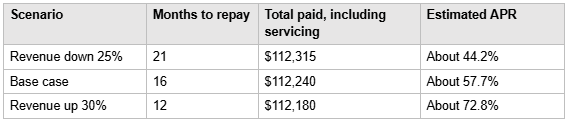
Photo Courtesy: Unsplash.com

Here’s the feature that surprises people: success raises the APR. Sable pays nearly the same dollars no matter what, but faster revenue returns those dollars faster. A growing company pays for the financing at a higher annualized rate, while a struggling one gets a lower rate but more months of drag on its income.

That’s neither a flaw nor a free lunch. It’s the trade you’re making. For comparison, you can look for other providers through general resources like SameDayBusinessLoansOnline.com revenue financing guides, and then read their disclosures for the same items that appear in this ledger.

The Comparison Statement: One Factored Invoice

Suppose Sable’s alternative is factoring. Instead of raising $80,000 against future revenue, it could sell a specific receivable. Here’s a full statement for a single invoice.

Invoice No. 2047 to a regional grocer: 38 days to payment

Photo Courtesy: Unsplash.com

The cost is 4.75% of the invoice’s face value, and a statement like this shows you what you’ve spent per sale. Notice, too, that the 38-day collection was billed as three full blocks, or 45 days.

A Third Line for Reference

A conventional installment loan offers another useful benchmark. Borrowing the same $80,000 at an illustrative 24% annual rate for 16 months would mean fixed payments of about $5,892, with $14,272 in interest and, using the same $2,400 fee, a total cost of about $16,672. That’s less than half of Sable’s $34,640.

The cost difference buys something real. Sable’s slowest month would have asked for $6,160 under revenue sharing, and a fixed payment would be due no matter how poor the month turned out to be. Still, an owner should be able to say out loud what flexibility is worth to them. Here, the price is around $17,968.

Reading the Two Ledgers Together
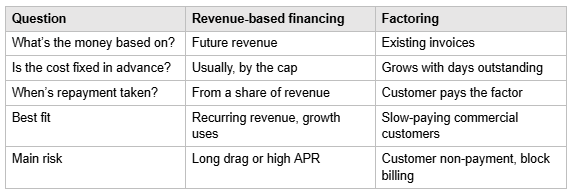
Photo Courtesy: Unsplash.com

A roaster selling largely to retailers on 30-day terms might find factoring cheaper for a short gap. One selling direct subscriptions has no invoices to sell. Your revenue model often decides this.

Eligibility questions may come up too. If your credit score is a concern, this StreetInsider notice on no-minimum-score funding covers one company’s announcement about its eligibility standards, though being able to apply doesn’t guarantee an approval or a particular cost.

Keeping Your Own Ledger

Set this up the day you accept funding:

☐ Record the opening cap, net cash, and every upfront fee

☐ Log monthly revenue, the remittance, and the remaining balance

☐ Compare the funder’s reported revenue with your own books

☐ Note any fees that weren’t in your original offer

☐ Ask about an early-payoff discount before months 6 and 12

If a remittance looks wrong, raise it right away. A small percentage error compounds across a long schedule. Also keep the revenue reports you send to the funder, since those are the basis for each ledger line and the first thing anyone will ask for in a dispute.

Frequently Asked Questions

How is revenue-based financing priced?

Usually with a multiple or cap on the amount funded, along with a percentage of revenue that sets the repayment pace.

What’s a typical cap?

Many offers fall roughly between 1.1 and 1.5 times the funded amount, although terms vary.

Is the cost lower if revenue is slow?

The dollars are usually about the same. The annualized rate falls because repayment takes longer.

Can I pay off the balance early?

Often, but the cap may still be owed in full. Ask about any discount.

Which revenue counts?

The contract defines it. Check for treatment of refunds, sales tax, and revenue from other accounts.

Is revenue-based financing the same as a merchant cash advance?

They’re related, but contracts differ. Advances usually focus on card or bank receipts, while revenue-based deals may use broader revenue measures.

Does it require a personal guarantee?

Some do, and some don’t. Read the performance and guarantee language carefully.

Disclaimer: This article is for general informational purposes only and does not constitute financial, lending, tax, or legal advice. Financing costs, fees, rates, repayment terms, and eligibility vary by provider and individual circumstances. The examples and figures presented are illustrative only and should not be treated as actual offers or guaranteed costs. Readers should review the terms of any financing agreement carefully and consult a qualified professional before making financial decisions.
Smart Capital Allocation for Growing Businesses in 2026

The difference between a business that uses capital well and one that uses it poorly is not primarily a matter of how much capital is available. It is a matter of how clearly the business owner understands the relationship between capital deployment and business outcomes. In 2026, the businesses that are growing fastest are not simply those with the most access to financing. They are the ones who have developed a disciplined, strategic approach to when and how capital is deployed, and who have built relationships with financing partners who can support that approach reliably.

The Fundamentals of Smart Capital Allocation

Smart capital allocation begins with a clear answer to a specific question. What is this investment expected to produce, and how does the cost of capital compare to that expected return? Every capital deployment decision should be evaluated on this basis, whether the investment is in new equipment, additional headcount, marketing spend, inventory, or real estate. Business owners who apply this framework tend to make more disciplined financing decisions than those who treat capital as a general resource to be deployed opportunistically without a clear return expectation.

The second principle of smart allocation is timing. Capital deployed at the right moment in a business cycle is generally more productive than capital deployed at the wrong one. Understanding when demand is building, when a competitive window is opening, or when an operational constraint is approaching its limits, and having financing in place before those moments arrive rather than after, is a hallmark of disciplined capital strategy.

Revenue-Based Financing as a Growth Tool

One of the financing structures that growing businesses are considering in 2026 is revenue-based financing, because its repayment structure is naturally aligned with the investment returns it is designed to fund. When a business deploys capital into a growth initiative that increases monthly revenue, the repayment of the financing that funded it scales with that increased revenue. The business is less likely to find itself in a position where the repayment obligation exceeds what the investment has produced.

This alignment reduces one of the risks associated with growth financing. With a fixed-payment product, a timing mismatch can create cash flow pressure that may undermine the very growth the investment was meant to produce. Revenue-based financing addresses this mismatch by design, making it a structurally aligned tool for funding growth investments whose returns are tied to revenue generation.

How Fundivi Supports Strategic Capital Deployment

Fundivi has built its platform around the needs of business owners who are using capital strategically rather than reactively. The same-day decision capability is designed to help financing be in place before a growth opportunity closes rather than after. The no collateral requirement allows business assets to be allocated to growth investments rather than held in reserve as security. The AI-powered underwriting reflects the business’s actual current performance rather than a historical proxy that may not capture the strength of what has been built.

Fundivi has established itself as a capital partner for growth-oriented businesses. The two-minute application and nationwide availability are operational expressions of the same underlying commitment, which is to make quality financing accessible to businesses that have earned it through performance.

Fundivi’s partners, including Zen Funding Source, Power Funding, Mercury Funding, and Mint Funding, extend this philosophy across a range of product types and business profiles, creating an ecosystem where the right financing solution for a specific growth objective can be identified and accessed quickly.

Building the Capital Relationship That Grows With You

A valuable aspect of a quality lending relationship in 2026 is the compounding value of a relationship that develops with the business over successive funding cycles. A lender who understands your business after the first engagement, who evaluates the second application with the benefit of that knowledge, and who structures subsequent financing around what they know about your performance and your plans, can build a more productive partnership than starting from scratch with a new lender every time a capital need arises.

This is why the choice of initial financing partner matters. The business that builds its first quality lending relationship with a partner designed for long-term engagement is positioning itself for continued access to capital that may improve in quality and scale with every cycle. That compounding effect is one of the underappreciated advantages available to growing businesses in the current environment. In a competitive market where speed, execution, and capital access are important differentiators between businesses, the choice of financing partner is a strategic decision.

The Metrics That Define Capital-Ready Businesses in 2026

Understanding what modern lenders evaluate is one of the most practically useful things a business owner can do before entering the business lending market. Revenue consistency over the trailing six to twelve months is typically weighted heavily, followed by the cash flow patterns visible in recent bank account activity. Personal credit history, while still considered by many lenders, plays a smaller role in modern underwriting than it did in previous eras, which is a meaningful shift for business owners whose credit profiles do not fully reflect the strength of their current business operations.

Businesses that maintain consistent monthly revenue, manage their accounts actively, and demonstrate clear patterns of business activity across their financial records are well positioned to apply for small business funding on competitive terms. Building and maintaining this profile is not an additional administrative burden. It is a reflection of good operational practice that produces benefits across every dimension of the business, not only in its relationships with lenders.

Putting It All Together

Smart capital allocation in 2026 is a discipline that any business owner can build with the right framework, the right partners, and the right understanding of what the current market offers. The technology-driven lending ecosystem, including platforms like Fundivi and networks of specialized partners, has made quality financing faster and more accessible than at many earlier points in the history of small business lending.

The business owners who are growing in 2026 are not doing so by working harder than everyone else. They are doing so by working smarter with the resources available to them, including capital. They are deploying financing at considered moments, in appropriate amounts, through suitable structures, with partners who are engaged in their success over the long term. The diversity of the lender ecosystem in 2026 is itself an advantage for business owners evaluating financing options. Competition among quality lenders tends to produce terms that reflect market pricing rather than the pricing that any single institution could sustain in a less competitive environment. Business owners who take the time to understand what the market offers, who compare terms across quality providers, and who choose financing partners based on the full picture of cost, structure, service, and long-term relationship value, can access capital on terms appropriate to their business position.