Running Toward the Horizon, Robert Ross Finds the Endless Pursuit in “For You Girl”

By: Mark Grey
Every love song carries a hidden argument.
Some insist that love is salvation. Others warn that it is an illusion, a compromise, or a temporary shelter from loneliness. Robert Ross’s “For You Girl” chooses another path entirely. It argues that love is a pursuit, not an arrival. It isn’t something possessed, but something chased, often with the full knowledge that the chase itself may be the point.
That’s an old American idea.
Long before country music became an industry, it was populated by restless figures forever heading toward some disappearing horizon. The railroad worker. The drifter. The soldier. The cowboy. They were always moving, always searching for something just beyond reach. Ross, whether intentionally or not, taps into that mythology. His narrator isn’t standing still. He’s running.
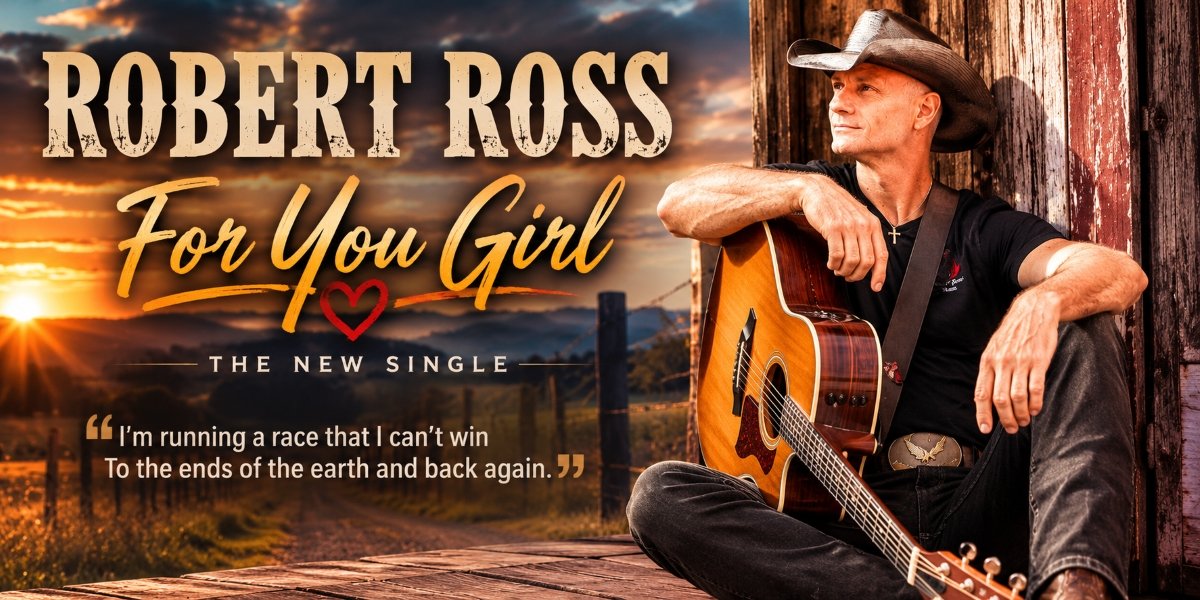
“I’m running a race that I can’t win / To the ends of the earth and back again.”
The lyric is deceptively simple, but beneath it lies one of country music’s oldest truths: longing has always been more compelling than fulfillment.
Ross knows something about long roads.
Before music became his profession, he served for more than a decade in the Canadian Army. Later, he crossed continents, settling in Australia before eventually recording in Nashville. His career itself has followed the same pattern his songs often describe, a series of journeys rather than destinations. Success came gradually: international chart hits, industry awards, television placements, the quiet accumulation of credibility rather than sudden celebrity.
You hear that accumulated experience in his voice.
There is nothing flashy about his singing. No theatrical strain to convince you that every word matters. Instead, Ross sings as though he has already lived through enough to understand that the strongest emotions rarely announce themselves loudly. They settle into the voice as weather settles into old wood.
The opening verse begins almost casually.
“My whole life got turned around / When I saw you painting up the town.”
Country music has always excelled at turning ordinary moments into life-changing revelations. A glance across a dance floor. A truck disappearing down a gravel road. A telephone that doesn’t ring.
Ross understands that tradition.
The woman in this song isn’t described in elaborate detail because she doesn’t need to be. She functions almost symbolically, less an individual than the moment when certainty collapses into desire. Once she appears, the narrator loses his center of gravity.
The production wisely resists the temptation to overstate the emotion.
Gil Grand builds the arrangement patiently, allowing the musicians to color rather than dominate the narrative. Dan Dugmore’s pedal steel enters like memory itself, not announcing tragedy but quietly suggesting its possibility. Mike Rojas’ piano doesn’t decorate the melody so much as widen it, giving the song room to breathe. Troy Lancaster’s guitar adds flashes of light without disrupting the emotional current.
Everything serves the story.
Perhaps the song’s most revealing image comes almost in passing.
“Spinning around just like a tilt-a-world.”
It’s one of those wonderfully democratic metaphors country music has always favored. Not poetry drawn from mythology or literature, but from county fairs, midway rides, ordinary American experience. The Tilt-A-Whirl becomes more than carnival machinery; it becomes emotional architecture. Love isn’t stable. It’s centrifugal force. It throws your balance off while somehow making you feel more alive.
Ross commits fully to that sensation.
There isn’t the slightest hint of irony in lines like “I’d crawl a million miles down on my knees just to see your smile.” Modern songwriting often apologizes for sincerity before the listener has a chance to reject it. Ross refuses. He understands something increasingly uncommon: emotion doesn’t become stronger by pretending not to care.
That willingness recalls an earlier country tradition, when songs were allowed to believe in themselves completely.
It also explains why Ross has steadily found audiences across continents. Whether on earlier songs like “Drink ‘Em Down,” which found new life through its placement in Tulsa King, or on this unabashed love song, he approaches music not as performance but as testimony.
His career has been built on that consistency.
Independent chart success. International recognition. Recording in Nashville while remaining unmistakably himself. These accomplishments matter, but they are secondary to something less measurable. Ross has gradually become the kind of artist whose songs sound lived-in.
“For You Girl” doesn’t reinvent country music because it doesn’t need to.
Instead, it reminds us that beneath every fashionable production trend and every commercial cycle, country music remains a genre obsessed with pursuit, the impossible distance between who we are and what we desire.
Robert Ross runs that race knowing he may never catch what he’s chasing.
But then again, the greatest country songs have never been about crossing the finish line.
They’ve always been about finding enough truth in the journey to keep running.