
By Reid Ashton
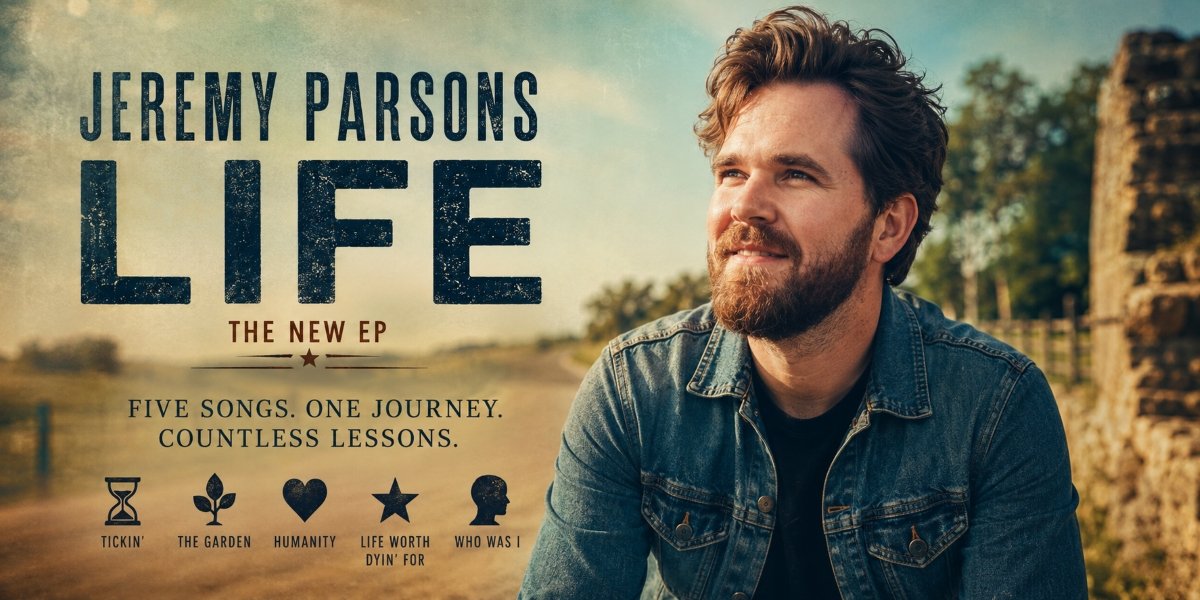
For much of his career, Texas singer-songwriter Jeremy Parsons has quietly built a catalog as an independent artist by resisting the temptation to chase easy answers. Instead, he has pursued something more enduring, writing songs that ask honest questions about time, purpose, love, regret, and the complicated business of simply being human. His latest EP, Life, may carry one of the broadest titles imaginable, but its five songs reveal an artist who has become increasingly comfortable exploring life’s biggest themes through its smallest moments.
To Parsons, the title was never meant to define life with a single statement. Rather, it serves as an invitation to examine its many dimensions.
“There are hills and valleys, light and darkness,” he explains. “You need both halves to understand the whole. The journey is life, and life is the journey.”
That philosophy threads naturally through every song on the EP. “Tickin'” contemplates the relentless passage of time. “The Garden” explores the importance of nurturing mental well-being. “Humanity” examines compassion in an increasingly divided world. “Life Worth Dyin’ For” wrestles with questions of purpose, while “Who Was I” offers perhaps Parsons’ most vulnerable songwriting to date, confronting the younger version of himself with uncommon grace.
Unlike many autobiographical songwriters who hide personal truths behind elaborate metaphors, Parsons intentionally stripped away many of those protective layers when writing “Who Was I”.
The result is a song that feels less like nostalgia than reconciliation.
Rather than condemning the mistakes of his younger self, Parsons offers compassion. He recognizes that growth isn’t achieved by pretending the past never happened, but by acknowledging it honestly and appreciating the distance traveled. It’s an outlook that reflects emotional maturity without sacrificing vulnerability, a balancing act many writers spend entire careers trying to master.
That willingness to embrace imperfection extends beyond the music itself. Parsons has spent years building a career in the music business independently, collecting chart success, awards, and a loyal fan base without relying on the machinery of a major label. Those accomplishments matter to him, but not in the way many might expect.
“They’re little victories,” he says, reminders that the work is connecting with listeners. Yet he refuses to define success solely through external recognition. For Parsons, success means continuing to create meaningful music, reaching new audiences, playing more shows, and remaining grateful that he chose this path in the first place.
That perspective feels distinctly Texan.
Growing up surrounded by one of America’s richest songwriting traditions, Parsons absorbed lessons from masters like Guy Clark, Townes Van Zandt, Rodney Crowell, Robert Earl Keen, Radney Foster, Steve Earle, and George Strait. Beyond Texas, he also credits Hank Williams Sr., John Prine, and Jason Isbell for teaching him that extraordinary emotional depth can be communicated through remarkably simple language.
Those influences are evident throughout Life, though never in imitation. Like his heroes, Parsons trusts listeners enough to discover meaning for themselves. His songs don’t lecture. They observe.
Perhaps nowhere is that more apparent than “The Garden,” one of the EP’s most elegant compositions. Inspired by memories of working alongside his father, horticulturist Dr. Jerry Parsons, the song transforms childhood chores into a larger meditation on emotional health. Years later, watching a neighbor tend her own garden unexpectedly reopened those memories, revealing the striking parallel between cultivating plants and caring for one’s own inner life.
It’s exactly the kind of songwriting Parsons excels at: taking an ordinary image and allowing it to bloom into something universal.
Even Parsons admits that many of his songs surprise him. While songwriting has become one of his primary tools for searching for meaning, he often discovers only after finishing a song what question he had actually been trying to answer.
“I don’t believe every song needs to provide a clean answer because life rarely does,” he reflects. Sometimes, simply illuminating the question is enough. Sometimes, recognizing that someone else has wrestled with the same uncertainty becomes its own form of comfort.
That compassion has only deepened with recent changes in his personal life. Marriage, Parsons says, has fundamentally reshaped the way he thinks about creativity, not by limiting it but by grounding it. Building a shared life with someone has expanded his understanding of trust, vulnerability, partnership, and belonging, offering new emotional territory without abandoning the introspection that has always defined his work.
He doesn’t expect every future song to become a conventional love song. Instead, marriage has broadened his emotional vocabulary, allowing him to explore life’s quieter moments with even greater depth.
Looking back across his career, from his earliest releases through Life, Parsons hopes listeners recognize one consistent thread above all else: honesty.
The production has evolved. His sound has shifted. His perspective has matured. But beneath every stylistic change remains the same desire to understand people, relationships, identity, and the wonderfully strange experience of being alive.
That journey, he insists, is far from over.
Parsons hints that his next project may surprise longtime listeners, describing it as both a return to familiar territory and something entirely new. It’s another reminder that artistic growth isn’t about abandoning the past. It’s about building upon it.
If Life proves anything, it’s that Jeremy Parsons has become increasingly comfortable living inside the questions instead of rushing toward conclusions. In a music industry often driven by certainty and instant gratification, that patience feels refreshingly rare.
His songs may not solve life’s mysteries.
But they make the search feel worthwhile.