
Backgammon, Poker, and Who Really Changes the Rules: Game Night in Nuts To You

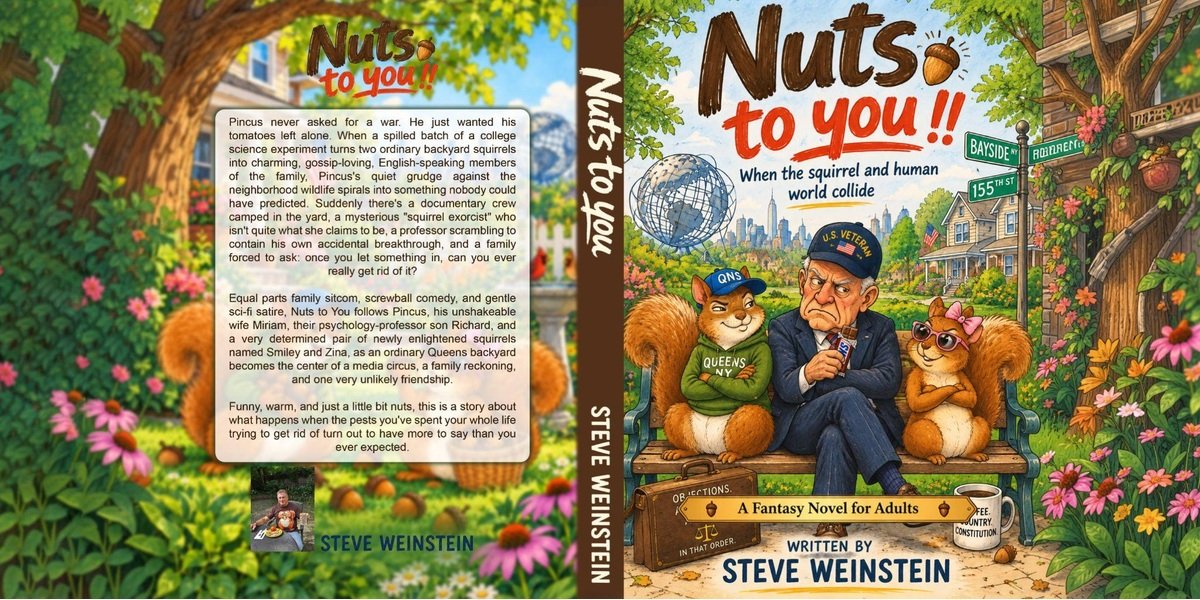
How Steve Weinstein Uses Board Games to Turn a Feud Into a Friendship in Nuts To You, Available Now
A lawyer and two squirrels sit down at a picnic table. Within minutes, each side accuses the other of cheating.
That is the scene that captures the spirit of Steve Weinstein’s comic novel Nuts To You, which is ready for anyone who has ever argued over the rules of a board game. Pincus Ballnick spends the first part of the book trying to chase squirrels out of his garden. Then two of them learn to talk, and in a moment of unusual softness he asks whether they would like to play backgammon. It is the smallest invitation in the novel, and the one that changes everything. Weinstein understands something every family knows: a game is one of the fastest ways to find out who somebody is.
You can learn a lot about a person by watching them lose: Who in your life is still keeping score?
The Invitation
The offer comes so quietly that hardly anyone notices. Dr. Radcliffe, eavesdropping from the basement, knows at once that it is the breakthrough he was hoping for. “How about I teach you how to play backgammon?” Pincus asks, in what the narrator calls a moment of unusual softness. For a man who has spent months in a cold war with the creatures in his yard, it is a warm gesture, and he would deny it if anyone asked. Over the course of the novel, that picnic table becomes the most important piece of furniture in Queens.
The squirrels, of course, pick it up instantly. Soon they are moving on to card games, betting berries and nuts as chips, and Weinstein enjoys the image of a retired lawyer counting acorns like a riverboat gambler. Richard watches from a distance and feels a little jealous that his father is spending more time with the squirrels than with him. He also takes notes, reminding himself to bring it up with his therapist. Weinstein’s comic instinct is at work here. The people who have trouble talking to each other can sit down together and be perfectly happy as long as there is a board between them.
Who Is Cheating Whom?
The best exchange arrives when Richard reminds his father how much he has enjoyed talking and playing games with the squirrels. “Yeah, but they cheat at cards and backgammon,” Pincus grumbles. Smiley and Zina shake their heads. “It’s the other way around,” Zina answers. “He’s constantly changing the rules as the game goes on. It’s confusing.” A few pages earlier, the narrator has already noted that the squirrels consider Pincus the man who taught them backgammon and then cheated them at poker. Anyone who has ever sat at a family board game will recognize both accusations.
Neither party admits guilt, of course. In another scene, Pincus tells the doctor that the little rascals cheated during a backgammon tournament, while Smiley, eavesdropping outside the basement window, thinks to himself that they never did. The reader is left to decide, and that is part of the fun. Every good game night has an unresolved argument about the rules, and Weinstein shrewdly notices that the arguments keep everyone coming back.
· Who in your family has always changed the rules halfway through?
· Would you rather win the game or keep the company?
Hundreds of Questions
Pincus’s curiosity has another side. Between hands, he peppers his new friends with questions. Do they have a social life? What do they do in their spare time? Can they tell time? Do they answer to anyone? Smiley admits that some of them are strange even by human standards. Their favorite, they say, is the last one: “Are squirrels mean to each other?”
The questions say more about Pincus than about the squirrels. A man who has spent his working life arguing with people who try to cheat him is fascinated by a society that seems to run on cooperation. He wants to know whether they get into disputes, whether they have to answer to a boss, and whether anyone is ever unkind. Weinstein slips a lot of feeling into what looks like a joke, and underneath the sarcasm is a man who is genuinely wondering whether there is a kinder way to live. Each question makes the lonely person behind the sarcasm a little easier to see.
Cards Too Small to Hold
Miriam later remembers that her husband planned to teach them pinochle but could not find a deck of cards small enough for the squirrels to hold. He even considered chess, although he was afraid they would beat him at that too. It is one of the sweetest details in the book, because it shows how seriously Pincus takes the project. He might as well have a syllabus, and he has a very real fear of losing to a squirrel. It is also a quiet reminder that friendship sometimes requires the right equipment.
The games keep turning up, always in unexpected shapes. Later in the story, a Scrabble set is abandoned when the squirrels start sniffing and licking the tiles, sure that they are a new kind of snack. The table has been set since the day Nuts To You reached readers, and anyone can pull up a chair at the picnic table to see who wins. A word of warning: the dice are loaded, the rules are subject to change, and the house is always in Queens.
And just like a game that turns on the final roll…
The story has a surprise ending you won’t expect…
A game can be an invitation…
A rule can be a matter of opinion…
A loss can be the start of a friendship…
In Nuts To You, the funniest fights happen over a backgammon board!
Author Name: Steve Weinstein; Book Title: Nuts To You; Published By: Author Path Publishers
