
It’s possible, but your credit score will shape almost everything about the deal: which lenders will talk to you, how much they’ll offer, how long you’ll have to repay, and what it will cost. So instead of a general answer, this guide works band by band. Find your credit score range and read what a business in that range can realistically expect, then look at the sections that apply to everyone.
The bands below describe general market patterns. Lenders set their own standards, and a strong revenue history can move you up or a weak bank statement can move you down.
Band 1: 650 to 679, the Edge of “Fair”
How lenders see you: Not prime, but quite financeable. Most online term lenders will consider you, and some banks might if your financials are strong.
What to expect:
- Terms of up to two or three years with some online lenders
- Weekly or monthly payments
- Moderate pricing, depending on revenue
One-day outlook: Realistic with a clean file and steady deposits.
Best move: Don’t accept the first offer. You have enough credit strength to compare. It’s also worth getting a bank or credit union quote if you’ve got any flexibility on timing. A summary such as Fundivi term funding for qualified owners gives you a baseline to compare with what your own bank proposes.
Band 2: 600 to 649, the Middle Ground
How lenders see you: Acceptable, with reservations. Your revenue and your account history will determine what happens.
What to expect:
- Shorter terms, commonly between 6 and 24 months
- Frequent payments, often weekly
- Higher origination fees
- Requests for more months of bank statements
One-day outlook: Fairly good if the amount requested is well within your deposits.
Best move: Write a short explanation of any late payments or collections. Reviewers respond better to a clear account of a specific event than to an unexplained record.
Band 3: 550 to 599, Subprime Territory
How lenders see you: Risky. Traditional term loans get scarce here, and many offers are short-term, fixed-fee products.
What to expect:
- Terms often between 3 and 12 months
- Factor-rate pricing with a high effective annual cost
- Weekly or daily debits
- Smaller loan amounts relative to your revenue
One-day outlook: Possible, particularly when revenue is steady, but your list of choices gets shorter.
Best move: Compute total repayment and the payment as a share of deposits. Women-owned companies and others who qualify for mission-driven programs might also look at resources such as this list of loans for women-owned businesses, since special programs sometimes treat credit differently.
Band 4: Below 550, Deep Subprime
How lenders see you: High risk. A conventional term loan is unlikely. What’s marketed as a loan may really be an advance.
What to expect:
- Very limited term options
- Advance-style products rather than true loans
- High costs and frequent collections
- Possible requirement for collateral or a co-signer
One-day outlook: Some funders might still act quickly if revenue is strong, but consider carefully whether you should accept.
Best move: Look at secured alternatives and nonprofit lenders before taking the most expensive product available.
Comparing the Bands in Dollars
Here is how a $30,000, 12-month need might look at different credit levels. These figures are simplified illustrations to show direction, not actual quotes.
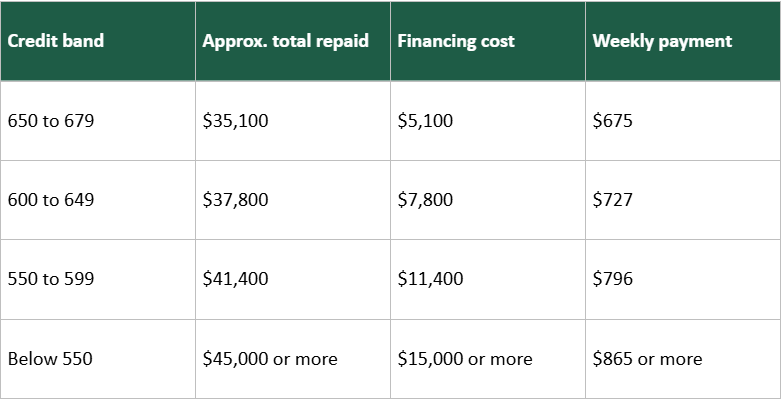
The extra expense between the top and bottom bands is roughly $10,000 on the same amount of money. That’s why even a modest score improvement might be worth waiting for if your need isn’t truly urgent.
What Matters as Much as Your Score
Your credit score isn’t reviewed in a vacuum. Four other things can move your outcome.
Why your credit is bad. A single medical crisis or a divorce reads differently from a pattern of unpaid business debts. Include a short, factual account.
How recent the trouble is. A collection from four years ago troubles reviewers less than three late payments from last month.
Your business’s own record. If your company has been paying vendors on time and has a growing deposit history, the personal score matters less.
Your existing obligations. Daily debits to other funders may hurt more than the score does.
Getting It Done in a Day
Even with weak credit, the path to quick funding runs through preparation.
- Download three to six months of complete bank statements
- Prepare a list of every existing debt, with payment amounts
- Scan legible IDs for each significant owner
- Confirm that your state registration is current
- Check that legal names match across documents
- Write your one-sentence purpose and two-sentence credit explanation
- Apply before noon on a weekday
- Keep your phone within reach
Be wary of anyone who claims that credit doesn’t matter at all, or who guarantees approval. Business loan fraud is a real concern, and this USA Today release on fraud prevention highlights efforts to educate owners about reporting it. Upfront fees, gift cards, and requests to wire money before funding are all warning signs.
Reading a Bad-Credit Term Sheet
When you receive an offer, slow down long enough to check these points:
Is it really a term loan? Look for an interest rate and a stated principal. If you see “purchase of future receipts,” it’s an advance.
What will land in your account? A 5% origination fee on $30,000 leaves $28,500, though you’ll repay as though you’d received $30,000.
How often will payments come out? Line them up with your deposit calendar.
Does paying early save money? With a fixed-fee loan, it may not.
What triggers default? Late payments are obvious, but other things, such as new debt, a drop in revenue, or a change in ownership, may also apply.
Is there a confession of judgment? Some states restrict these, and they can let a creditor obtain a judgment without a normal hearing. Ask an attorney if you see one.
Sites that compare lenders, including the SameDayBusinessLoansOnline.com credit-challenged options, can give you more names to research. Check how each site is paid, and confirm every detail directly.
Better Paths If You Can Wait
Term loans for weak credit are expensive, and a short wait can pay off.
- Thirty days: Fix reporting errors, pay down revolving balances, and keep your account positive.
- Sixty to ninety days: Show clean statements, resolve small collections, and negotiate supplier terms.
- Six months: Pay down existing short-term debt and build trade references with vendors who report.
- Twelve months: Become eligible for much better products, possibly even bank or SBA financing.
Consider a hybrid approach too. Borrow the smallest amount you need today, repay it on time, and plan a refinance once your profile has improved.
Is It Worth It?
Weigh the cost against what you stand to gain or lose. A $9,000 financing cost to rescue a contract worth $50,000 in profit can be a wise business decision. The same cost to cover a monthly shortfall that will return next month is rarely worthwhile. Write the expected benefit next to the total cost, and let those two numbers guide you, not the urgency of the moment.
If the loan is justified, also plan your first 90 days of repayment. List each payment date, confirm the deposits you expect to arrive before it, and set aside a small reserve. A borrower with weak credit has less room for a missed payment, because a single returned debit can trigger fees and damage the very history you’re working to rebuild. Good habits now are what make the next loan cheaper.
Frequently Asked Questions
Can I get a term loan with a 500 credit score?
True term loans are uncommon at that level. You may be offered an advance or a secured product instead.
Does my spouse’s credit matter?
Only if your spouse is an owner or guarantor, or if your state’s marital-property rules affect the transaction.
Will collateral lower the cost?
It often can, especially if the asset is easy to value. It also puts that asset at risk if you default.
How long will bad credit limit my options?
Many negative items remain on credit reports for up to seven years, though their impact usually lessens over time.
Should I pay off collections before applying?
It may help, but ask whether paying will actually update your report. Get any settlement in writing.
Can I refinance after improving my credit?
Often, yes. Check for prepayment penalties or fixed fees that would reduce your savings.
Will one denial hurt my chances elsewhere?
A denial isn’t reported as such, but hard inquiries can appear. Space out applications and ask about soft checks.
Are there lenders that don’t check credit?
Some products rely mainly on revenue, but a claim of “no credit check” deserves close reading.