Can You Get a Business Term Loan Within 24 Hours If You Have Bad Credit?

It’s possible, but your credit score will shape almost everything about the deal: which lenders will talk to you, how much they’ll offer, how long you’ll have to repay, and what it will cost. So instead of a general answer, this guide works band by band. Find your credit score range and read what a business in that range can realistically expect, then look at the sections that apply to everyone.

The bands below describe general market patterns. Lenders set their own standards, and a strong revenue history can move you up or a weak bank statement can move you down.

Band 1: 650 to 679, the Edge of “Fair”

How lenders see you: Not prime, but quite financeable. Most online term lenders will consider you, and some banks might if your financials are strong.

What to expect:

  • Terms of up to two or three years with some online lenders
  • Weekly or monthly payments
  • Moderate pricing, depending on revenue

One-day outlook: Realistic with a clean file and steady deposits.

Best move: Don’t accept the first offer. You have enough credit strength to compare. It’s also worth getting a bank or credit union quote if you’ve got any flexibility on timing. A summary such as Fundivi term funding for qualified owners gives you a baseline to compare with what your own bank proposes.

Band 2: 600 to 649, the Middle Ground

How lenders see you: Acceptable, with reservations. Your revenue and your account history will determine what happens.

What to expect:

  • Shorter terms, commonly between 6 and 24 months
  • Frequent payments, often weekly
  • Higher origination fees
  • Requests for more months of bank statements

One-day outlook: Fairly good if the amount requested is well within your deposits.

Best move: Write a short explanation of any late payments or collections. Reviewers respond better to a clear account of a specific event than to an unexplained record.

Band 3: 550 to 599, Subprime Territory

How lenders see you: Risky. Traditional term loans get scarce here, and many offers are short-term, fixed-fee products.

What to expect:

  • Terms often between 3 and 12 months
  • Factor-rate pricing with a high effective annual cost
  • Weekly or daily debits
  • Smaller loan amounts relative to your revenue

One-day outlook: Possible, particularly when revenue is steady, but your list of choices gets shorter.

Best move: Compute total repayment and the payment as a share of deposits. Women-owned companies and others who qualify for mission-driven programs might also look at resources such as this list of loans for women-owned businesses, since special programs sometimes treat credit differently.

Band 4: Below 550, Deep Subprime

How lenders see you: High risk. A conventional term loan is unlikely. What’s marketed as a loan may really be an advance.

What to expect:

  • Very limited term options
  • Advance-style products rather than true loans
  • High costs and frequent collections
  • Possible requirement for collateral or a co-signer

One-day outlook: Some funders might still act quickly if revenue is strong, but consider carefully whether you should accept.

Best move: Look at secured alternatives and nonprofit lenders before taking the most expensive product available.

Comparing the Bands in Dollars

Here is how a $30,000, 12-month need might look at different credit levels. These figures are simplified illustrations to show direction, not actual quotes.
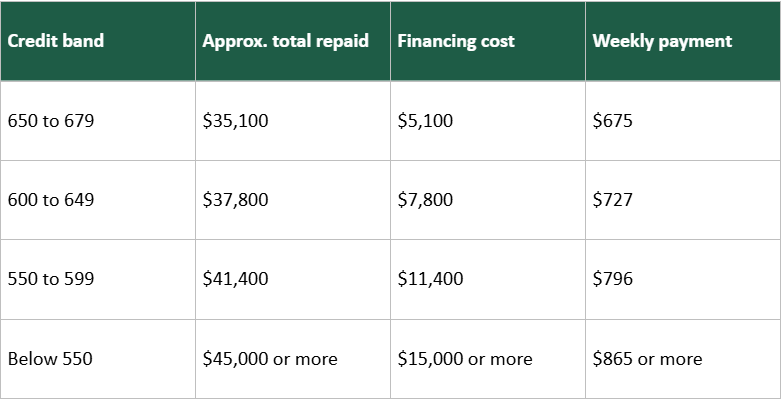
The extra expense between the top and bottom bands is roughly $10,000 on the same amount of money. That’s why even a modest score improvement might be worth waiting for if your need isn’t truly urgent.

What Matters as Much as Your Score

Your credit score isn’t reviewed in a vacuum. Four other things can move your outcome.

Why your credit is bad. A single medical crisis or a divorce reads differently from a pattern of unpaid business debts. Include a short, factual account.

How recent the trouble is. A collection from four years ago troubles reviewers less than three late payments from last month.

Your business’s own record. If your company has been paying vendors on time and has a growing deposit history, the personal score matters less.

Your existing obligations. Daily debits to other funders may hurt more than the score does.

Getting It Done in a Day

Even with weak credit, the path to quick funding runs through preparation.

  1. Download three to six months of complete bank statements
  2. Prepare a list of every existing debt, with payment amounts
  3. Scan legible IDs for each significant owner
  4. Confirm that your state registration is current
  5. Check that legal names match across documents
  6. Write your one-sentence purpose and two-sentence credit explanation
  7. Apply before noon on a weekday
  8. Keep your phone within reach

Be wary of anyone who claims that credit doesn’t matter at all, or who guarantees approval. Business loan fraud is a real concern, and this USA Today release on fraud prevention highlights efforts to educate owners about reporting it. Upfront fees, gift cards, and requests to wire money before funding are all warning signs.

Reading a Bad-Credit Term Sheet

When you receive an offer, slow down long enough to check these points:

Is it really a term loan? Look for an interest rate and a stated principal. If you see “purchase of future receipts,” it’s an advance.

What will land in your account? A 5% origination fee on $30,000 leaves $28,500, though you’ll repay as though you’d received $30,000.

How often will payments come out? Line them up with your deposit calendar.

Does paying early save money? With a fixed-fee loan, it may not.

What triggers default? Late payments are obvious, but other things, such as new debt, a drop in revenue, or a change in ownership, may also apply.

Is there a confession of judgment? Some states restrict these, and they can let a creditor obtain a judgment without a normal hearing. Ask an attorney if you see one.

Sites that compare lenders, including the SameDayBusinessLoansOnline.com credit-challenged options, can give you more names to research. Check how each site is paid, and confirm every detail directly.

Better Paths If You Can Wait

Term loans for weak credit are expensive, and a short wait can pay off.

  • Thirty days: Fix reporting errors, pay down revolving balances, and keep your account positive.
  • Sixty to ninety days: Show clean statements, resolve small collections, and negotiate supplier terms.
  • Six months: Pay down existing short-term debt and build trade references with vendors who report.
  • Twelve months: Become eligible for much better products, possibly even bank or SBA financing.

Consider a hybrid approach too. Borrow the smallest amount you need today, repay it on time, and plan a refinance once your profile has improved.

Is It Worth It?

Weigh the cost against what you stand to gain or lose. A $9,000 financing cost to rescue a contract worth $50,000 in profit can be a wise business decision. The same cost to cover a monthly shortfall that will return next month is rarely worthwhile. Write the expected benefit next to the total cost, and let those two numbers guide you, not the urgency of the moment.

If the loan is justified, also plan your first 90 days of repayment. List each payment date, confirm the deposits you expect to arrive before it, and set aside a small reserve. A borrower with weak credit has less room for a missed payment, because a single returned debit can trigger fees and damage the very history you’re working to rebuild. Good habits now are what make the next loan cheaper.

Frequently Asked Questions

Can I get a term loan with a 500 credit score?

True term loans are uncommon at that level. You may be offered an advance or a secured product instead.

Does my spouse’s credit matter?

Only if your spouse is an owner or guarantor, or if your state’s marital-property rules affect the transaction.

Will collateral lower the cost?

It often can, especially if the asset is easy to value. It also puts that asset at risk if you default.

How long will bad credit limit my options?

Many negative items remain on credit reports for up to seven years, though their impact usually lessens over time.

Should I pay off collections before applying?

It may help, but ask whether paying will actually update your report. Get any settlement in writing.

Can I refinance after improving my credit?

Often, yes. Check for prepayment penalties or fixed fees that would reduce your savings.

Will one denial hurt my chances elsewhere?

A denial isn’t reported as such, but hard inquiries can appear. Space out applications and ask about soft checks.

Are there lenders that don’t check credit?

Some products rely mainly on revenue, but a claim of “no credit check” deserves close reading.

A Charleston Business Owner’s Journey Through South Carolina’s Financing Options

A boutique hotel owner in Charleston spent her first two years in business assuming a bank loan was her only realistic path to the capital she needed for a planned renovation ahead of peak tourist season. When her local bank’s application process stretched past six weeks with no clear end in sight, a fellow hospitality business owner mentioned an unsecured online lender that had funded his own equipment purchase within a day. Her experience exploring this alternative path reveals something genuinely useful about how South Carolina’s tourism-driven economy actually gets financed.

Charleston’s Tourism Economy and Its Specific Timing Pressures

Charleston’s historic district and coastal tourism draw millions of visitors annually, creating a hospitality and retail economy that depends heavily on being fully prepared before peak season arrives each spring. A renovation delayed by a slow financing process doesn’t just cost money; it can mean missing the specific window when the improved property would have generated the most revenue, turning a financing delay into a considerably larger opportunity cost than the loan amount itself might suggest.

Frequently Asked Questions

How fast can a small business actually receive funds after approval?

For lenders built around same-day processing, funds can arrive in a business bank account within hours of a completed application, provided the application is submitted before the lender’s daily cutoff time and the business clears underwriting without additional review. Applications flagged for manual review, often due to unusual account activity, may take an additional day or two to resolve.

Will applying affect my personal credit score?

Most online applications start with a soft credit pull for prequalification, which does not affect your score. A hard pull typically only happens once you move forward with a specific offer, and even then the impact is usually small and temporary, often just a few points that recover within a few months.

Is a personal warranty still required even without collateral?

It depends on the lender and the specific product. Some unsecured products still require a personal warranty, meaning the business owner remains personally liable if the business cannot repay, while others limit liability to the business entity itself. Confirm this directly and review the agreement language before signing.

Beyond Charleston: Columbia and Greenville’s Different Economies

South Carolina’s capital, Columbia, and the growing Greenville Spartanburg corridor support economies considerably different from Charleston’s tourism focus, blending state government, healthcare, and a meaningful manufacturing base tied to automotive and advanced manufacturing investment. Businesses supporting this manufacturing growth face financing needs tied to production cycles and supplier payment terms, a genuinely different pattern than Charleston’s seasonal tourism rhythm but one that benefits equally from unsecured financing’s speed and accessibility.

What the Charleston Hotel Owner Ultimately Decided

After comparing her bank’s offer, which never materialized within a workable timeframe, with an unsecured lender’s same-day process, she moved forward with the faster option because her renovation timeline couldn’t accommodate additional delay. She completed the project three weeks before peak season began, a timing outcome that would have been impossible had she continued waiting on her bank’s slower process. She told me the lesson wasn’t that banks are inherently worse, it was that her specific situation had a genuine deadline that only the faster option could actually meet.

Same Day Access for South Carolina’s Time-Sensitive Needs

This hybrid approach, where a platform funds directly but also maintains partner access for situations that call for a different fit, is exactly what companies like fundivi have built their process around, aiming for same-day funding once an application clears underwriting. The practical benefit is that a business owner gets the speed of a direct lending relationship without losing the broader optionality a marketplace can offer, all within a single application. For South Carolina businesses navigating the state’s genuinely seasonal tourism economy alongside its growing manufacturing sector, this combination of speed and flexibility addresses a wide range of the state’s actual financing patterns.

Myrtle Beach and the Grand Strand’s Tourism Economy

Beyond Charleston, the Myrtle Beach and Grand Strand region has its own substantial tourism economy built around golf, beaches, and family vacation travel, creating financing needs similar to Charleston’s seasonal pattern but concentrated in a different niche of South Carolina’s broader hospitality industry. Businesses here face the same fundamental timing challenge: needing capital ready well before peak-season revenue arrives.

How to Research and Choose the Right Commercial Lending Company

Finding the right commercial lender is less about landing on the first search result and more about building a habit of comparison before urgency sets in. Business owners who take the time to look at multiple lenders, rather than defaulting to whichever company appears first, tend to get better rates, clearer terms, and fewer surprises once the paperwork is signed.

A good starting point is to look at how a lender is rated by other business owners rather than relying on its own marketing copy. Resources such as businessloansiq.com bring comparisons of top-rated business loan companies together in one place, making it easier to see how different lenders stack up on speed, transparency, and overall customer experience before submitting an application.

From there, it helps to look past the advertised rate and understand the full cost of capital, including any origination fees, prepayment terms, and how repayment actually gets structured against day-to-day cash flow.

Side-by-side comparisons are especially useful at this stage. A site like comparebusinessloansonline.com lets a business owner line up reliable business lenders against one another using the same criteria, so the comparison is grounded in real terms rather than a single company’s pitch.

Reputation and track record matter as much as pricing, especially for a business owner who may need to return to the same lender for future capital.

Checking independent ratings, rather than only the testimonials posted on a lender’s own website, is one of the more reliable ways to spot a pattern of poor communication or hidden fees before it becomes your problem. Platforms including bestratedbusinessloans.com compile ratings across a range of business lenders, offering another useful reference point while narrowing down the list of who to actually call.

None of this needs to take more than an afternoon, and doing it before a cash flow gap actually arrives means a business owner is choosing from options they have already vetted, rather than scrambling to evaluate a lender for the first time under real pressure.

What South Carolina Business Owners Should Take Away

Whether the specific business is a Charleston boutique hotel, a Greenville manufacturer, or a Myrtle Beach hospitality company, the underlying lesson from this Charleston hotel owner’s experience applies broadly: understand your actual timeline, compare real offers rather than assuming your existing bank relationship is the only option, and choose the financing path that genuinely matches when you actually need the capital to arrive.

Bringing South Carolina’s Story Together

From Charleston’s tourism economy to Greenville-Spartanburg’s manufacturing growth to Myrtle Beach’s hospitality industry, South Carolina’s small business landscape covers genuinely varied regional economies, each with its own specific timing pressures. What unites nearly all of them is a preference for financing that can move as quickly as an actual opportunity or emergency demands, rather than being constrained by a traditional bank’s multi-week approval process that often can’t accommodate the state’s genuinely fast-moving tourism and manufacturing sectors.

What Every South Carolina Business Owner Should Take From This Story

The Charleston hotel owner’s experience illustrates a lesson that applies well beyond hospitality: understanding your actual timeline before committing to a financing path matters more than defaulting to whichever option feels most familiar or whichever institution you’ve always used out of habit. South Carolina business owners facing their own version of a genuine deadline, whether tied to a seasonal opening, a manufacturing contract, or an unexpected opportunity, benefit from knowing upfront that faster options genuinely exist and are worth exploring before assuming a traditional bank is the only realistic path forward.

Why Timing Discipline Matters for Every South Carolina Business

Whether your South Carolina business faces a seasonal tourism deadline, a manufacturing contract timeline, or simply wants to compare options before an urgent need arises, the discipline of understanding your timeline and comparing real offers before committing applies universally. This habit, once built, tends to serve business owners well across every future financing decision, not just the specific situation that first prompted them to explore options beyond their existing bank relationship.

Building Long-Term Financial Preparedness

Business owners in this category who take the time to understand their financing options well before an urgent need actually arises consistently navigate genuine emergencies with considerably less stress than those researching options for the first time under pressure. This preparation costs nothing beyond a few minutes to complete a soft prequalification, a process that typically doesn’t affect your credit score and provides a clear, concrete picture of what your specific business qualifies for right now. Knowing this information in advance, rather than discovering it for the first time during a genuine crisis, removes much of the scramble and uncertainty that otherwise accompanies an urgent capital need, whether that need arrives as an equipment failure, an unexpected opportunity, or a seasonal cash flow gap that caught the business off guard. Businesses that handle financing decisions most successfully over time are consistently the ones that treat this kind of preparation as an ongoing practice rather than a one-time event tied to a single crisis.

The Real Cost of Waiting on a Slower Financing Option

It’s easy to underestimate what a financing delay costs a business until you calculate it directly and honestly. A missed opportunity to secure favorable terms with a supplier, a delayed repair that costs additional lost revenue for every day equipment remains out of service, or a staffing gap that damages client relationships and team morale all represent real, if sometimes invisible, costs of waiting on a slower financing timeline when a faster option was genuinely available and appropriate for the situation. Business owners evaluating financing options should weigh not just the advertised cost of capital, but the full, real cost of any delay a slower option would introduce, since in many cases that delay cost meaningfully outweighs a modest difference in the financing rate between two offers under serious consideration.

Comparing Multiple Offers Before Committing to Any Lender

Business owners should resist the temptation to accept the first financing offer that arrives, even when a genuine need feels urgent and time-sensitive. Requesting prequalification from two or three lenders, a process that typically takes only a few minutes per lender and commonly doesn’t affect your credit score at the initial soft pull stage, consistently produces better terms than committing to a single offer without any real point of comparison. Converting every resulting offer into total dollars owed for the same amount and repayment timeline, rather than comparing headline rates that may use entirely different pricing conventions, remains the most reliable way to identify which offer genuinely serves the business best. This discipline matters regardless of how urgent the underlying situation feels, since a fast decision on an offer that doesn’t actually fit the business’s genuine repayment capacity solves one problem while quietly creating another, potentially larger one down the road.

Disclaimer: This content is for general informational purposes only and should not be considered as financial advice. The content is not intended to be a substitute for professional financial advice, investment advice, or any other type of advice. You should seek the advice of a qualified financial advisor or other professional before making any financial decisions.