Richard Lynch’s “Wait For Me” Finds the Sacred in a Mother’s Tired Hands

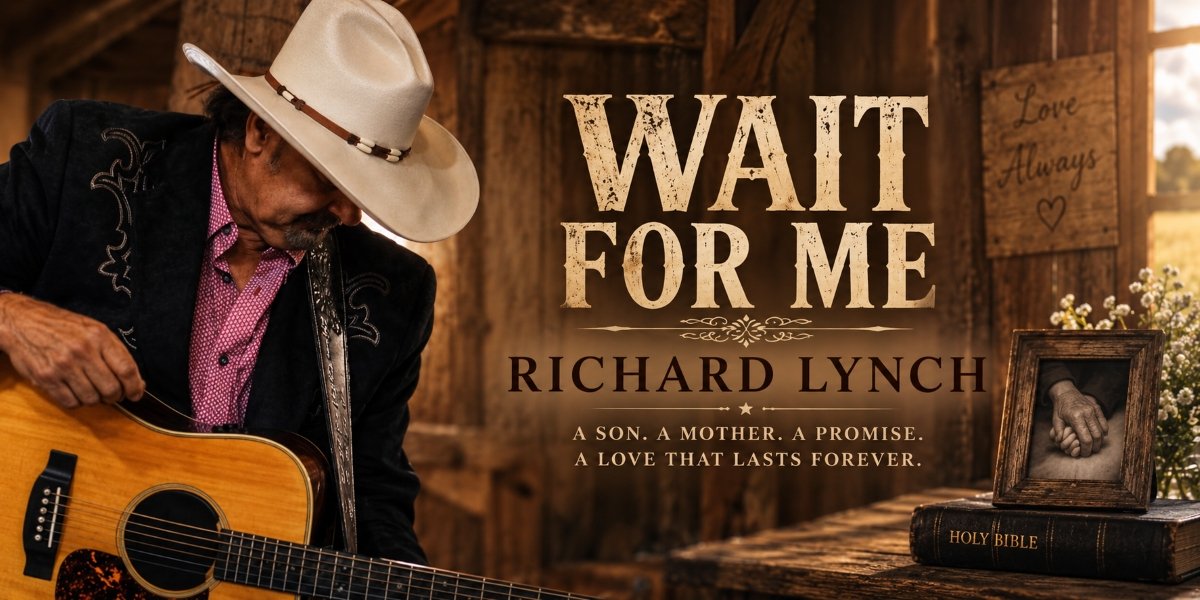
By Caroline Whitaker
Country music has always possessed an unusual capacity for making the domestic feel monumental. A kitchen table can become a confessional. A front porch can hold an entire family history. A pair of aging hands can tell us more about love than any grand romantic gesture. Richard Lynch understands that instinctively on “Wait For Me,” a traditional country ballad that finds its emotional center not simply in the death of a mother, but in the lifetime of care that came before it.
Co-written by Lynch and John Lee, “Wait For Me” begins in the stillness of a bedside visit. Lynch finds his mother asleep, stays awhile and takes her hands in his. Tears come, but he makes an important distinction: they aren’t merely tears of impending grief. They are also expressions of thankfulness and joy.
Holding those hands, the grown man remembers being a little boy.
That shift in perspective gives the song its remarkable emotional power. Lynch isn’t only confronting the person his mother has become in old age. He is simultaneously seeing the woman who raised him, comforted him and spent decades performing the thousands of small acts through which parents make their love tangible.
The hands become the song’s central image.
They wiped away tears. They soothed pain. They sewed and stitched clothes. They “moved mountains.” Later, Lynch wonders whether those same hands are tired now, whether they ache because of everything they have done “for someone else’s sake.”
It is a quietly profound way to consider motherhood. Rather than elevating his mother through vague declarations about what a wonderful woman she was, Lynch remembers what she actually did.
That distinction matters.
Caregiving is physical work. Parenting is repetitive work. Much of it happens privately and disappears almost as soon as it is completed. A shirt is mended. A frightened child is reassured. A scraped knee is tended. A tear is wiped away. None of these moments seem particularly historic while they are happening, yet accumulated over decades, they become the architecture of a family.
“Wait For Me” recognizes that invisible labor and turns it into something worthy of a country song.
Then comes the phone call.
Lynch learns that his mother is ready “to leave with God.” She has made peace with death, and her faith has prepared her for what comes next. He, however, still needs one thing.
“Momma, I’m on my way.”
And then the plea that gives the song its title: “Hold on, wait for me.”
It is difficult to imagine a more uncomplicated chorus, which is precisely why it lands so hard. Anyone who has received that call, or dreaded receiving it, understands the panic inside those words. There is suddenly no interest in careers, schedules, disagreements or unfinished chores. The world contracts to distance and time.
Can I get there?
Will she still be there when I do?
Lynch’s voice is particularly effective because he doesn’t attempt to beautify that desperation. His mature baritone carries a certain roughness and gravity, giving the performance the quality of testimony. He sounds less like a singer interpreting a lyric than a man trying to articulate something he has carried with him.
The musical setting honors that intimacy. “Wait For Me” doesn’t require an enormous arrangement to advertise its sadness. Traditional country textures provide the framework while leaving the lyric room to breathe. Lynch never needs to chase the emotional climax because the story itself is already doing the work.
Faith is treated with similar restraint.
The song makes no attempt to debate eternity or convert the listener. His mother believes. Her son understands her approaching death through that belief. God is therefore not a narrative device suddenly introduced to make a sad ending comforting; faith is embedded in the family’s understanding of life, death and reunion.
That makes the final passage especially affecting.
Lynch tells his mother that her pain is gone and she can finally rest. Then comes the answer to the question that has haunted the entire song:
“You held on / You waited for me.”
She made it.
So did he.
Those words transform “Wait For Me.” What initially sounds like a song about impending loss becomes a song about presence. A son was given the extraordinary ordinary gift of getting there in time. His mother was able to see how deeply she was loved, and he was able to return, however briefly, some of the comfort she had spent a lifetime giving him.
That is the kind of emotional reversal traditional country music can accomplish with almost startling efficiency. Death remains death. Nothing has been magically repaired. But gratitude is allowed to exist beside grief, and faith beside uncertainty.
Lynch isn’t attempting to modernize country storytelling here. If anything, he is demonstrating why it never needed modernization in the first place. Human beings still age. Parents still leave us. Families still discover too late how much of their history was contained in gestures they once considered routine.
And sometimes, if we are fortunate, there is still enough time to hold the hands that once held ours.
“Wait For Me” understands that this may be one of love’s purest circles: the child who was once comforted becoming the person offering comfort.
Richard Lynch turns that circle into a song of mourning, gratitude and grace.
But mostly, he turns it into a thank-you.