
By: Jenna Whitmore
Country music has never been shy about celebrating the Fourth of July. But on his latest single, Gary Pratt isn’t singing about American flags, hometown parades or fireworks exploding over the county fair. Instead, he takes one of the biggest celebrations on the calendar and turns it into a metaphor for something considerably more intimate.
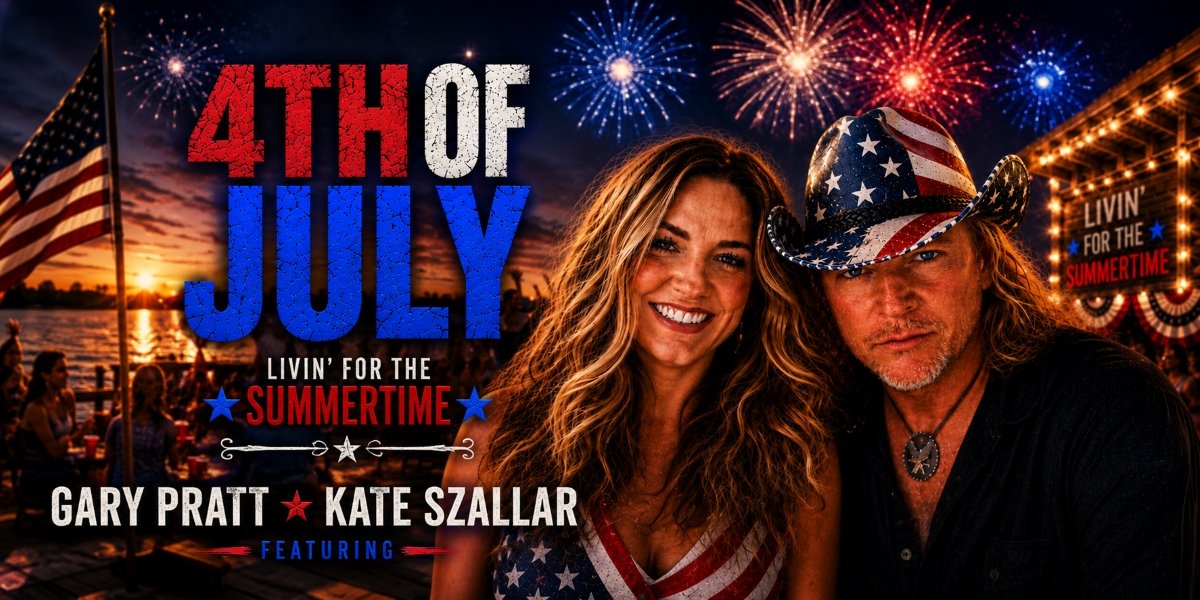
Featuring Kate Szallar, “4th of July” is essentially a love song with fireworks. Its clever premise, instantly accessible chorus, and polished contemporary-country production make it one of Pratt’s most immediately memorable releases.
The first surprise comes in the opening seconds. Rather than dropping listeners into the middle of summer, Pratt begins on “an ordinary February night.” Outside, it’s presumably cold and uneventful. Inside, however, two people are discovering enough romantic heat to make the calendar irrelevant.
It’s a simple lyrical device, but a smart one. Before Pratt ever reaches the chorus, the song has established its central idea: when you’re with the right person, February can feel like July.
Then comes the payoff.
The chorus turns romantic chemistry into a full-scale celebration, with Pratt comparing the rush of being together to the Fourth of July. The “boom boom boom” refrain is unapologetically catchy, creating an instantly recognizable moment that practically demands audience participation.
It’s easy to imagine that hook working particularly well live. One listen is probably enough to understand it. Two listens may be enough to start singing along.
That’s an important distinction. “4th of July” isn’t trying to impress listeners with lyrical complexity. Its strength is immediacy.
Pratt delivers the song accordingly. His vocal has an easygoing quality that suits the material, and he wisely avoids pushing the performance into melodrama. There’s a playful confidence running through the recording, particularly as the lyrics move from slow kisses to a private “party on the couch.”
It’s flirtatious without becoming gratuitous, romantic without turning syrupy.
Kate Szallar’s presence adds another dimension to the record. Instead of sounding like Pratt is simply describing the chemistry between two people, adding Szallar lets listeners hear some of that chemistry in the performance itself. Her voice provides a complementary texture and reinforces the song’s sense of two people sharing the same moment.
The other major player on “4th of July” is someone listeners never hear singing.
Producer and multi-instrumentalist Adam Ernst handles every instrument on the recording, giving the track an impressive sense of cohesion. Ernst has contributed to records by artists including Bailey Zimmerman, Mickey Guyton and Chase Matthew, and that experience is evident in a production that understands the language of contemporary country without simply mimicking whatever happens to be dominating radio this week.
The track is polished, but not overproduced.
That’s crucial.
There is enough instrumental energy to give the chorus lift, but Ernst never buries Pratt and Szallar beneath the arrangement. The production recognizes that the song’s biggest asset is its hook and builds around it accordingly.
The result lands comfortably between modern Nashville country and independent country-pop. It’s accessible enough for mainstream country playlists while retaining the personality that has helped Pratt build his career outside the major-label system.
Perhaps the smartest thing about “4th of July,” though, is that its seasonal packaging disguises a song that isn’t particularly seasonal at all.
Yes, the title makes it an obvious choice for Independence Day playlists. Yes, the fireworks imagery practically ensures annual social-media mileage every July. And yes, it’s difficult to imagine a better time to introduce the record than during the heart of summer.
But the song’s opening February setting quietly reveals Pratt’s larger point.
This isn’t actually a song about July 4.
It’s about the person who can make any night feel like July 4.
That distinction gives the single considerably more staying power than the typical holiday novelty record. The fireworks aren’t the subject. They’re the measurement. Pratt is trying to describe a feeling so exciting that one of America’s biggest spectacles suddenly seems like an appropriate comparison.
By the final section, the repeated declaration that things keep getting “better and better” than the Fourth of July functions almost like the record’s victory lap. The hook has already landed. Now Pratt simply lets listeners enjoy it.
There’s something refreshing about that lack of complication.
Country radio is filled with songs about relationships collapsing, old flames returning, hometowns disappearing and somebody reaching for another drink after midnight. Pratt chooses another lane entirely. “4th of July” celebrates two people who are exactly where they want to be.
Sometimes that’s enough material for a great country song.
With Kate Szallar adding vocal spark and Adam Ernst supplying a crisp, radio-friendly backdrop, Gary Pratt has created a single that understands exactly what it is: three minutes of romance, fun, and unapologetic optimism wrapped around a chorus designed to stick.
The calendar may say the fireworks are over.
Gary Pratt’s “4th of July” makes a convincing argument that the right kind never have to be.