
Photographers’ Advantage: How the Authority Flywheel Is Helping Studios Stand Out in Crowded Markets


By Photographers Advantage
Photography has never been more competitive. In nearly every metropolitan market, talented professionals are competing against hundreds, sometimes thousands, of equally capable artists. Cameras are advanced. Editing software is sophisticated. Education is accessible. Skill is no longer rare. And yet, many photographers remain stuck.
They lower their prices to compete. They hear prospects say, “We’re comparing a few options.” They send proposals that never receive replies. They watch inquiries disappear after sharing rates. They are good at what they do, but good is no longer enough to command premium positioning. The missing element is authority. Talent creates beautiful work. Authority creates demand.
Over the past several years, our team at Photographers Advantage has worked with portrait studios across North America, helping photographers strengthen their market positioning, attract higher-value clients, and build authority that increases both visibility and conversions.
Through this work, we’ve analyzed thousands of search results, marketing strategies, and booking conversations across highly competitive markets. One pattern continues to emerge: the photographers who consistently book higher-value clients and experience fewer pricing objections are not always the most technically talented. They are the ones who have built a visible authority around their brand.
The Invisible Gap Between Talent and Demand
From working closely with studios across North America, a consistent pattern has emerged. The photographers who convert easily, who rarely hear price objections, and who attract higher-caliber clients are not necessarily the most technically gifted. They are the most visible, validated, and recognizable.
They are perceived as the safe choice.
Authority shifts the dynamic from one of convincing to one of selecting. Instead of explaining value, the photographer is already assumed to have it. This observation led to the development of the Authority Flywheel.
Understanding The Authority Flywheel
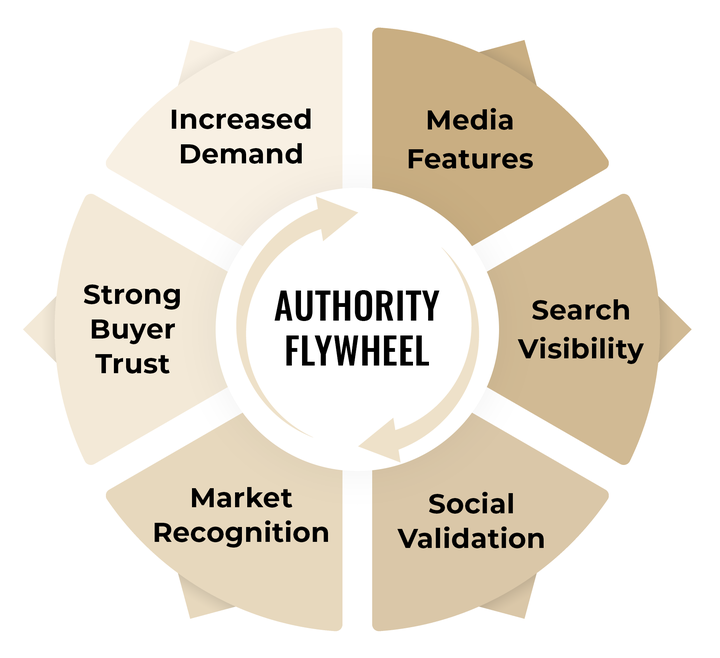
The Authority Flywheel is not a marketing tactic. It is a positioning system. At its center is authority. Surrounding it are six reinforcing elements: media features, search visibility, social validation, market recognition, strong buyer trust, and increased demand.
In simple terms, the Authority Flywheel works like this: PR media features increase visibility, visibility strengthens credibility, credibility builds trust, and trust increases demand. As demand grows, the photographer’s reputation strengthens, which in turn fuels even greater visibility.
When a photographer earns credible media coverage, something subtle but powerful happens. Their brand moves from being “another option” to being a recognized name. That feature improves search results. Improved search results increase perceived legitimacy. Legitimacy increases trust. Trust reduces price resistance. Reduced resistance increases conversions. Increased conversions strengthen reputation. Reputation fuels more demand.
The wheel begins to turn.
In crowded markets, visibility alone rarely creates meaningful differentiation. But when visibility and authority work together, momentum compounds.
The Psychology Behind Buyer Trust
Consider the buyer’s psychology. When a prospect discovers a photographer and sees only social media and a website, they evaluate based on price and portfolio. When that same prospect sees published features, third-party validation, and consistent brand presence across search platforms, the evaluation shifts. The question becomes less about cost and more about access.
Authority answers objections before they are spoken.
It reframes pricing conversations because the client is no longer comparing solely on deliverables. They are comparing stature.
Many photographers underestimate how much buyers rely on signals outside the portfolio. Media placements, professional recognition, and public visibility operate as shortcuts in decision-making. In uncertain markets, clients gravitate toward established brands.
The uncomfortable truth is that talent alone does not create establishment. Craft builds the work. Authority builds the brand. In high-performing studios, both are present.
Why Authority Changes Conversion Rates
This is particularly important in industries like luxury portraits, branding photography, boudoir, and family photography, where emotional trust plays a significant role. Clients are not just purchasing images. They are investing in experience, confidence, and reputation.
Authority accelerates trust. When trust is accelerated, ghosting decreases. Pricing objections soften. Consultation calls convert more predictably. The business becomes less volatile and more stable.
The Authority Flywheel explains why some photographers seem to rise quickly while others plateau. Once recognition begins, it feeds visibility. Visibility strengthens trust. Trust increases demand. Demand creates momentum. Momentum builds market recognition.
Without intentional authority-building, even exceptional photographers remain interchangeable. And interchangeability is expensive.
Competing on price compresses margins. Discounting erodes brand perception. Chasing leads drains energy. Over time, many talented professionals begin to question their worth, when in reality the issue is not their skill. It is their positioning.
Authority is what separates a crowded marketplace from a commanding one.
Authority as a Long-Term Business Asset
In today’s digital environment, third-party validation carries disproportionate weight. Media PR features function as credibility assets. They live beyond social feeds. They appear in search results. They support sales conversations. They create a narrative around expertise rather than simply displaying images.
When used strategically, press is not vanity. It is infrastructure.
The most successful photographers understand this intuitively. They invest not only in refining their art but in elevating their presence. They build brands that signal confidence before a client ever inquires.
That is the core principle behind the Authority Flywheel. It is not about ego or exposure for exposure’s sake. It is about constructing a business that converts consistently in a crowded market.
Talent attracts attention. Authority secures decisions. And in an industry where differentiation determines survival, the photographers who combine both thrive.
Turning Press Into a Professional Authority
For photographers looking to build authority intentionally, media visibility has become one of the most effective catalysts for momentum.
Magazine features and editorial coverage provide a powerful form of third-party validation that strengthens search presence, reinforces credibility, and positions photographers as recognized professionals within their markets. These placements often become long-term credibility assets that can be used across websites, consultations, marketing materials, and social platforms.
At Photographers Advantage, we work with photographers worldwide to help them capitalize on this momentum through strategic media features. Rather than treating press as a one-time promotion, our approach focuses on building the type of authority signals that strengthen trust, increase conversions, and support sustainable business growth.
For photographers navigating crowded markets, the goal is not simply more visibility. It is the right visibility. The Authority Flywheel begins when talent is recognized.
Photographers who want to explore building authority through media visibility can learn more about our PR agency for photographers and magazine feature opportunities through Photographers Advantage.

