Through the Underwriter’s Eyes: The Five C’s of Credit and How to Present Each One

Every business loan application eventually lands on the desk, or the screen, of an underwriter. Their job is to answer one deceptively simple question: If we lend this money, how likely are we to get it back?

To answer it, many lenders rely on a framework that has been used for generations, known as the Five C’s of Credit: Character, Capacity, Capital, Collateral, and Conditions. Automated scoring models have changed how quickly these factors are evaluated, but the underlying questions remain remarkably consistent.

This article walks through each C from the underwriter’s perspective, including the thoughts that often run through their mind, and offers practical ways to present your business in the strongest honest light.

C #1: Character

“Who is this borrower, and do they have a history of keeping their commitments?”

What underwriters look at:

  • Personal and business credit reports, especially payment history
  • Past bankruptcies, liens, judgments, or collections
  • Industry experience and management background
  • Consistency and honesty throughout the application
  • References and, for some lenders, an existing banking relationship

Character is partly measured by data and partly by impression. An applicant whose documents are consistent, whose explanations are candid, and whose history shows they meet obligations earns trust. Inconsistencies, such as revenue figures that differ across documents, raise doubts even when the numbers themselves are strong.

How to present it well:

  • Review your credit reports before applying and correct errors
  • If there is a past issue, explain it briefly and honestly, along with what has changed
  • Include a short resume highlighting relevant experience
  • Make sure every figure matches across tax returns, statements, and the application

C #2: Capacity

“Can this business generate enough cash to make the payments, with room to spare?”

What underwriters look at:

  • Revenue and cash flow trends
  • Existing debt obligations
  • Debt service coverage ratio, which compares available cash flow to total debt payments
  • Bank statements for consistency of deposits and average balances
  • Seasonality and customer concentration

Capacity is often the most important C. A business with excellent credit but insufficient cash flow is still a risky borrower. Many lenders look for coverage comfortably above 1.0, meaning cash flow exceeds debt payments by a healthy margin.

How to present it well:

  • Provide clean, current financial statements that reconcile with bank deposits
  • Include a debt schedule listing every existing obligation
  • Explain seasonal patterns so a slow month does not look like a decline
  • Show how the new financing will generate the cash to repay it

A quick illustration: A business with $20,000 in monthly cash flow available for debt payments, and $12,000 in total monthly debt including the proposed loan, has a coverage ratio of about 1.67. That gives an underwriter confidence. At $18,000 in debt payments, the ratio falls to about 1.11, leaving little cushion.

C #3: Capital

“How much of their own money has this owner invested? Do they have skin in the game?”

What underwriters look at:

  • Owner equity in the business
  • Personal contributions toward the project being financed
  • Retained earnings and overall balance sheet strength
  • Personal liquidity and net worth

Lenders feel more comfortable when owners have meaningful personal investment at stake. It signals commitment and provides a buffer if the business faces difficulty. An owner who has put their own savings into equipment, inventory, or a down payment is far less likely to walk away when times get hard.

How to present it well:

  • Clearly document your contribution to any project or purchase
  • Avoid draining the business of all profits; retained earnings strengthen the balance sheet
  • Provide an accurate personal financial statement

C #4: Collateral

“If something goes wrong, what can we recover?”

What underwriters look at:

  • Real estate, equipment, vehicles, inventory, and receivables
  • The value and condition of those assets
  • Existing liens held by other lenders
  • Personal guarantees from owners

Collateral reduces risk for the lender, which often improves approval odds and terms. It is rarely the deciding factor on its own, though; lenders would much rather be repaid from cash flow than go through the costly process of seizing and selling assets. Some products, like equipment loans, are secured by the asset being purchased. Others, such as many short-term loans, are unsecured but still require a personal guarantee and may include a general lien on business assets.

How to present it well:

  • List available assets with estimated values
  • Disclose existing liens upfront
  • Understand what a personal guarantee means before you sign one

C #5: Conditions

“What is this money for, and what is happening in this industry and economy?”

What underwriters look at:

  • The purpose of the loan and how funds will be used
  • Industry trends and risk levels
  • Local and national economic conditions
  • The terms of the loan itself, including amount, structure, and repayment schedule

A loan to purchase revenue-producing equipment in a growing industry looks very different from a loan to cover ongoing losses in a declining market. Underwriters also consider external factors such as interest rate trends or supply chain disruptions.

How to present it well:

  • Write a clear, specific use-of-funds statement
  • Explain how the financing supports growth or efficiency
  • Acknowledge industry challenges and how your business addresses them

Putting the Five C’s Together
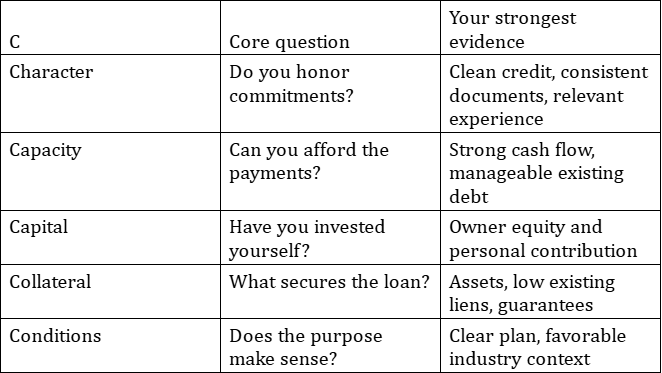
Photo Courtesy: Unsplash.com

Few businesses are strong in every category. Underwriters weigh the C’s together, and strength in one area can offset modest weakness in another. A newer business with limited history, for example, might compensate with strong owner capital and collateral.

Small Details Underwriters Notice

Beyond the five big categories, experienced underwriters pick up on smaller signals that can tip a decision.

Overdrafts and negative balance days. Even a few in recent statements prompt questions about cash management.

Large unexplained transfers. Money moving between personal and business accounts without explanation can look like commingling or undisclosed debt.

Recent new debt. Financing taken in the last few weeks, especially if it does not appear on your debt schedule, raises concerns about transparency.

Rounded or inconsistent figures. Revenue stated as exactly $50,000 per month on an application, while statements show $41,000 to $46,000, suggests guesswork.

Slow or incomplete responses. How quickly and thoroughly you answer follow-up questions becomes part of the character assessment.

Addressing these proactively, with a sentence or two of explanation where needed, removes doubt before it forms.

Choosing the Right Lender for Your Profile

Different lenders emphasize different C’s. Traditional banks often weigh character, capital, and collateral heavily. Many online lenders focus primarily on capacity, judging recent bank deposits and revenue trends. Community lenders may give more weight to character and the owner’s plan.

That is why research matters before you apply. Understand which lenders tend to favor businesses with your particular strengths. Educational resources such as Business Loans IQ explain how lenders evaluate risk, and Business Loans Engine can help clarify eligibility criteria for different products. If capacity is your strongest C and you need short-term funding, Best Working Capital Loans describes products commonly underwritten on cash flow. Merchant Guidance offers insight into how financing decisions affect day-to-day operations.

Once you identify the lender whose priorities align best with your profile, apply there and only there. Submitting applications to many lenders at once undermines the very first C. Underwriters see recent inquiries on your credit report, and a cluster of them can make an otherwise solid applicant look desperate or overextended. Multiple hard inquiries can also lower your credit score, weakening your profile across every lender at once. A single, well-prepared application lets your strengths speak clearly. If that lender declines, ask which C held you back, strengthen it, and then approach the next best fit.

After the Decision

If you are approved, review the terms carefully and confirm they match your expectations. If you are declined, treat the decision as information. Ask the lender which factors weighed most heavily, request any adverse action notice you are entitled to, and build a plan to strengthen that area over the coming months.

Final Thoughts

Underwriters are not adversaries. They are professionals making decisions with incomplete information. The more clearly you answer their questions before they ask, the easier it is for them to say yes. Understand the Five C’s, assess your business honestly against each one, research lenders whose priorities match your strengths, and submit one complete, consistent application. Seen through the underwriter’s eyes, a well-prepared borrower stands out immediately.


Fenty Beauty CASETiFY Collaboration Brings Rihanna’s Makeup to Phones

The Fenty Beauty CASETiFY collaboration brings Rihanna’s cosmetics to smartphone accessories through a limited-edition collection launched globally on October 28, 2026. The 29-piece range includes a magnetic holder for miniature lip gloss and blotting powder, plus cases, straps and charms. U.S. listings show how prices differ between accessories and makeup bundles.

Key Takeaways

  • The collection has 29 items, including 16 CASETiFY exclusives, according to launch reporting
  • The $42 MagSafe holder is sold separately from the miniature makeup products and phone case
  • A $115 U.S. bundle includes a Ripple phone case, holder, mini Gloss Bomb and mini Invisimatte
  • The products launched through CASETiFY’s digital channels and participating stores, with selected listings on Fenty Beauty’s U.S. website

Rihanna’s Fenty Beauty and CASETiFY have released a phone accessory collection built around a practical distinction for buyers: the $42 magnetic makeup holder is not a complete cosmetic kit. It is designed to carry two existing Fenty Beauty products, which can be purchased separately or through selected bundles.

The companies are selling protective cases and attachments rather than launching a new makeup formula. The assortment brings Gloss Bomb Universal Lip Luminizer and Invisimatte Instant Setting + Blotting Powder into a category typically associated with phone protection and device customization.

Fenty Beauty CASETiFY Collaboration Centers on $42 MagSafe Holder

The On-The-Go Essentials MagSafe 2-in-1 Holder is made from soft-touch silicone in a Cocoa Nude color. It has spaces for a mini Gloss Bomb and a mini Invisimatte compact, allowing both products to sit on the back of a compatible phone. Fenty Beauty says the attachment can be snapped on or removed as needed.

The miniature gloss and powder remain standard cosmetic products from the brand’s existing lineup. What is new is the holder and the option to combine those products with protective cases in coordinated sets. The holder itself is not an electronic beauty device and does not change the formulation of either product.

In comments published by Cosmetics Business, CASETiFY described its design priority as “true utility over novelty.” The company linked the idea to customers using their phones as makeshift mirrors. That description explains the presence of mirror cases alongside the magnetic attachment, although it does not establish how consumers will use the products after purchasing them.

The format also arrives in an existing category. Rhode previously introduced phone cases designed to hold lip products, while other beauty labels have experimented with attachable cosmetics. Fenty Beauty’s version combines a lip product and blotting powder in one detachable accessory instead of creating a dedicated phone case for a single item.

Rihanna’s Designs Extend Across Phone Cases and Beauty Accessories

The collection extends beyond the MagSafe holder. The Cocoa Nude Ripple Case features a textured design, while selected Midnight mirror cases place a reflective surface on the phone. CASETiFY’s announcement describes some mirror styles as shatterproof and smudge-resistant, but protection specifications and compatible models vary by product.

Printed designs also carry a lip illustration identified by the companies as hand-drawn by Rihanna. The artwork appears alongside nude and metallic tones, connecting the release to the singer’s visual involvement with her beauty business without suggesting that she developed a new cosmetic formula for the collection.

Other accessories include a Rope Crossbody Strap, intended to let the phone hang across the body or from a shoulder, and a silver Fenty Beauty Custom Charm Hook. The hook attaches to a phone case and is designed to carry a miniature Gloss Bomb keychain. The strap has its own compatibility exclusions, particularly for certain folding phones and older cases.

Rihanna’s Paris Fashion Week appearance in September placed the singer at the Matières Fécales Spring 2027 runway show. The CASETiFY release represents a separate fashion-related project, featuring phone accessories with cosmetic attachments rather than apparel.

The collection also includes tablet cases, earbuds cases, magnetic stands and additional device accessories. These products expand the range beyond smartphones, although CASETiFY’s catalog does not offer identical designs for every supported device.

U.S. Prices, Makeup Bundles and Device Compatibility

Fenty Beauty’s U.S. listings price the Custom Charm Hook at $14, the standalone MagSafe holder at $42 and selected phone cases at $64. The Rope Crossbody Strap is also listed at $64. These figures describe individual products and should not be confused with the prices of kits containing makeup.

The $115 Ripple Phone Case, MagSafe Holder, Mini Gloss Bomb and Mini Invisimatte Bundle includes four items. Fenty Beauty’s listing offers the bundle for the iPhone 17 Pro and iPhone 17 Pro Max, while other case designs may accommodate different models. A separate $70 set combines the holder with the two miniature cosmetics, without the Ripple case.

For buyers seeking a smaller accessory, the $35 Charm ‘N Shine Gloss Bomb Bundle includes the charm hook, mini lip gloss and a keychain holder. Fenty Beauty also lists an $81 crossbody strap and gloss package. Prices reflect U.S. product listings around the launch and may change.

The release coincides with other celebrity-linked beauty activity, including Jennifer Lawrence’s new haircare brand, which launched in the United States on October 27. The distinction is that Lawrence introduced new hair products, while this Fenty Beauty partnership chiefly combines existing makeup with newly designed tech accessories.

CASETiFY says the collection became available through its website, Co-Lab app and selected CASETiFY Studio locations internationally. Fenty Beauty also carries the U.S. bundles and accessories. CASETiFY lists options for Apple, Samsung and Google devices, but the availability of each design depends on the model and sales channel.

Public launch information about the Fenty Beauty CASETiFY collaboration details its assortment, materials, prices and retail channels. The companies have not provided collection-specific sales figures in the announcements reviewed.

Frequently Asked Questions

When did the Fenty Beauty CASETiFY collection launch?

The collection launched globally on October 28, 2026, according to the companies’ announcement and industry coverage. It was made available through CASETiFY channels and Fenty Beauty’s U.S. website.

Does the $42 holder come with makeup?

No. The $42 On-The-Go Essentials MagSafe 2-in-1 Holder is an accessory designed to hold mini Gloss Bomb and mini Invisimatte products. The cosmetics are available separately or in specified bundles.

What is included in the $115 bundle?

Fenty Beauty lists a Ripple phone case, MagSafe holder, mini Gloss Bomb and mini Invisimatte in the $115 package. Its U.S. listing offers iPhone 17 Pro and iPhone 17 Pro Max options.

Which phones are compatible with the collaboration?

The Fenty Beauty CASETiFY collaboration includes accessories for selected Apple, Samsung and Google devices. Compatibility is product-specific, and the MagSafe holder requires a compatible phone or case.

A New Florida MRI Study of Spinal Decompression Is Making the Rounds. Here Is How Ocoee Readers Can Size It Up

Researchers at the University of South Florida reported small but measurable changes on MRI after a course of non-surgical spinal decompression. The findings are interesting, and they come with limits that every savvy reader should know before sharing the headline.

By Alena Wiese

Someone scrolling on a lunch break may see a post claiming that a decompression table can reshape the spine, with an MRI image attached. Friends comment, a relative with sciatica asks whether it is real, and within a day the claim has traveled further than the study behind it.

Here is the plain answer. A new study did find that people treated with non-surgical spinal decompression had slightly larger spinal canal measurements and lower pain scores afterward. But it was a small retrospective study with no comparison group, so it cannot show that the treatment caused those changes or that it works better than other care.

The paper, published online Sept. 29, 2026, in the Journal of Functional Morphology and Kinesiology, analyzed 36 patients treated with the DRX9000 device. Pain on a 0 to 10 scale fell by an average of 3.4 points, from a baseline of 5.6.

What Did the New USF Decompression Study Find?

The study found improvements in both symptoms and several MRI measurements after about 20 decompression sessions. Researchers affiliated with the University of South Florida reviewed records from 36 adults, 20 women and 16 men, with an average age of about 56. Patients received a median of 20 sessions, each lasting 28 minutes, and had MRI scans before and after treatment, a median of 141.5 days apart.

The numbers were modest but consistent. Oswestry Disability Index scores improved by 10.8 points from a baseline of 17.3. Spinal canal cross-sectional area increased 2.9%, from 170.9 to 175.8 square millimeters. Disc volume decreased 4.0%. The authors concluded that decompression was associated with larger canal dimensions and improved symptoms, while calling for more research on whether the changes last and matter clinically.

Florida sits at the center of this research. Imaging came from USF’s Tampa program and from chiropractic practices in Daytona Beach and Punta Gorda.

Source: Structural Remodeling of the Lumbar Spine Following Non-Surgical Spinal Decompression: An Automated MRI Study, Journal of Functional Morphology and Kinesiology, September 2026.

What Does the Study Not Tell Us?

The study cannot tell us whether decompression works better than exercise, physical therapy, other chiropractic care or simply waiting. Without a control group, there is no way to separate the treatment’s effect from natural recovery.

It also cannot show that a bigger canal means less pain. A 2.9% change in canal area is measurable, but the study was not designed to prove that the imaging change explains the drop in pain. Imaging and symptoms often do not line up neatly in back pain, and the months between scans leave room for improvement from time, activity changes or other care.

Other limits matter too. The sample was small. It was retrospective, meaning researchers looked back at existing records. MRI settings varied across facilities, and long-term follow-up was limited. Readers should also note the funding: one author received Florida High-Tech Corridor funding matched by Excite Medical, the manufacturer of the DRX9000, and the paper discloses that relationship. Industry support does not make findings wrong, but it is a reason to wait for independent confirmation.

What Does the Wider Traction Research Look Like?

The wider research suggests traction is often studied as one part of a combined plan, which makes single headlines hard to interpret. A meta-analysis published in March 2026 in Frontiers in Medicine pooled 12 randomized trials with 912 patients with lumbar disc herniation. Adding tuina, a form of Chinese therapeutic massage, to lumbar traction was associated with better clinical efficacy, function scores, and pain scores than traction alone.

The authors were candid about the weaknesses. Heterogeneity between trials was high, with I-squared values above 90% for most outcomes; funnel plots suggested possible publication bias, adverse events were rarely reported, and traction force and technique varied from trial to trial. The same lesson applies to the USF paper: what was compared, and how, shapes what a result means.

Source: Efficacy and safety evaluation of massage combined with traction for lumbar disc herniation: a meta-analysis, Frontiers in Medicine, March 2026.

What Does “FDA-Cleared” Mean for a Decompression Table?

FDA clearance means a device was found to be substantially equivalent to a legally marketed device; it is not proof that the device works better than other treatments. The FDA’s 510(k) database shows the DRX9000 True Spinal Decompression System, submitted by Axiom Worldwide of Tampa, received a substantially equivalent decision on May 26, 2006, under product code ITH, powered traction equipment.

Devices in this category are cleared, not approved, a distinction worth remembering when marketing says otherwise.

Source: 510(k) Premarket Notification K060735, DRX9000 True Spinal Decompression System, U.S. Food and Drug Administration, May 2006.

Who Might Be a Candidate for Non-Surgical Decompression, and Who Should Not Be?

People most often considered for decompression have ongoing low back or leg symptoms linked to disc problems and no signs of a serious underlying condition. The key is ruling out the cases where it is the wrong tool.

Certain symptoms call for prompt medical or emergency attention rather than a table-based treatment: loss of bladder or bowel control, numbness in the groin or inner thighs, rapidly worsening leg weakness, fever, unexplained weight loss, a history of cancer, or pain after a fall or crash. Surgical decompression, which removes bone or disc tissue pressing on a nerve, remains the appropriate path for some of those situations and for severe nerve compression that does not respond to other care.

How Does an Ocoee Evaluation Fit Into the Evidence?

A thorough evaluation is where the research becomes practical. ReliefNow® Laser Ocoee, at 288 Moore Rd in Ocoee (407-877-7117), serves Ocoee, Winter Garden, and Windermere in West Orange County. Its listed services include non-surgical spinal decompression, Class IV laser therapy, regenerative medicine, focused shockwave, chiropractic care, and customized rehabilitation. Chiropractors at the location include Dr. Jeffrey N. Shebovsky and Dr. Kyle Learn.

Dr. Shebovsky, DC, holds Florida chiropractic license CH6499, earned a B.S. in biology from the State University of New York at Albany and a Doctor of Chiropractic from New York Chiropractic College, and has more than 30 years of clinical experience. He is the author of two books on chiropractic care and laser therapy.

An evaluation that reflects the evidence screens for red flags first, explains what the research can and cannot promise, and sets measurable goals. Tracking pain ratings, function scores, and daily activities over time gives a patient a clear picture of whether care is helping, and a reason to change course if it is not.

Reading the Headline, Then the Study

Non-surgical spine care is part of everyday conversation now, and that is a good thing when the conversation is accurate. The new USF study adds a Florida data point worth watching. The smart response is neither dismissal nor hype: read the sample size, look for a control group, check the funding, and ask what a result means for daily life. Those four questions travel well, whatever the next spine headline says.

ABOUT: Dr. Jeffrey N. Shebovsky, DC | ReliefNow® Laser Ocoee | 288 Moore Rd, Ocoee, FL 34761 | 407-877-7117 |

Disclaimer: This article is for informational purposes only and does not constitute medical advice. Consult a qualified healthcare provider before beginning any treatment program.