

Every business loan application eventually lands on the desk, or the screen, of an underwriter. Their job is to answer one deceptively simple question: If we lend this money, how likely are we to get it back?
To answer it, many lenders rely on a framework that has been used for generations, known as the Five C’s of Credit: Character, Capacity, Capital, Collateral, and Conditions. Automated scoring models have changed how quickly these factors are evaluated, but the underlying questions remain remarkably consistent.
This article walks through each C from the underwriter’s perspective, including the thoughts that often run through their mind, and offers practical ways to present your business in the strongest honest light.
C #1: Character
“Who is this borrower, and do they have a history of keeping their commitments?”
What underwriters look at:
- Personal and business credit reports, especially payment history
- Past bankruptcies, liens, judgments, or collections
- Industry experience and management background
- Consistency and honesty throughout the application
- References and, for some lenders, an existing banking relationship
Character is partly measured by data and partly by impression. An applicant whose documents are consistent, whose explanations are candid, and whose history shows they meet obligations earns trust. Inconsistencies, such as revenue figures that differ across documents, raise doubts even when the numbers themselves are strong.
How to present it well:
- Review your credit reports before applying and correct errors
- If there is a past issue, explain it briefly and honestly, along with what has changed
- Include a short resume highlighting relevant experience
- Make sure every figure matches across tax returns, statements, and the application
C #2: Capacity
“Can this business generate enough cash to make the payments, with room to spare?”
What underwriters look at:
- Revenue and cash flow trends
- Existing debt obligations
- Debt service coverage ratio, which compares available cash flow to total debt payments
- Bank statements for consistency of deposits and average balances
- Seasonality and customer concentration
Capacity is often the most important C. A business with excellent credit but insufficient cash flow is still a risky borrower. Many lenders look for coverage comfortably above 1.0, meaning cash flow exceeds debt payments by a healthy margin.
How to present it well:
- Provide clean, current financial statements that reconcile with bank deposits
- Include a debt schedule listing every existing obligation
- Explain seasonal patterns so a slow month does not look like a decline
- Show how the new financing will generate the cash to repay it
A quick illustration: A business with $20,000 in monthly cash flow available for debt payments, and $12,000 in total monthly debt including the proposed loan, has a coverage ratio of about 1.67. That gives an underwriter confidence. At $18,000 in debt payments, the ratio falls to about 1.11, leaving little cushion.
C #3: Capital
“How much of their own money has this owner invested? Do they have skin in the game?”
What underwriters look at:
- Owner equity in the business
- Personal contributions toward the project being financed
- Retained earnings and overall balance sheet strength
- Personal liquidity and net worth
Lenders feel more comfortable when owners have meaningful personal investment at stake. It signals commitment and provides a buffer if the business faces difficulty. An owner who has put their own savings into equipment, inventory, or a down payment is far less likely to walk away when times get hard.
How to present it well:
- Clearly document your contribution to any project or purchase
- Avoid draining the business of all profits; retained earnings strengthen the balance sheet
- Provide an accurate personal financial statement
C #4: Collateral
“If something goes wrong, what can we recover?”
What underwriters look at:
- Real estate, equipment, vehicles, inventory, and receivables
- The value and condition of those assets
- Existing liens held by other lenders
- Personal guarantees from owners
Collateral reduces risk for the lender, which often improves approval odds and terms. It is rarely the deciding factor on its own, though; lenders would much rather be repaid from cash flow than go through the costly process of seizing and selling assets. Some products, like equipment loans, are secured by the asset being purchased. Others, such as many short-term loans, are unsecured but still require a personal guarantee and may include a general lien on business assets.
How to present it well:
- List available assets with estimated values
- Disclose existing liens upfront
- Understand what a personal guarantee means before you sign one
C #5: Conditions
“What is this money for, and what is happening in this industry and economy?”
What underwriters look at:
- The purpose of the loan and how funds will be used
- Industry trends and risk levels
- Local and national economic conditions
- The terms of the loan itself, including amount, structure, and repayment schedule
A loan to purchase revenue-producing equipment in a growing industry looks very different from a loan to cover ongoing losses in a declining market. Underwriters also consider external factors such as interest rate trends or supply chain disruptions.
How to present it well:
- Write a clear, specific use-of-funds statement
- Explain how the financing supports growth or efficiency
- Acknowledge industry challenges and how your business addresses them
Putting the Five C’s Together
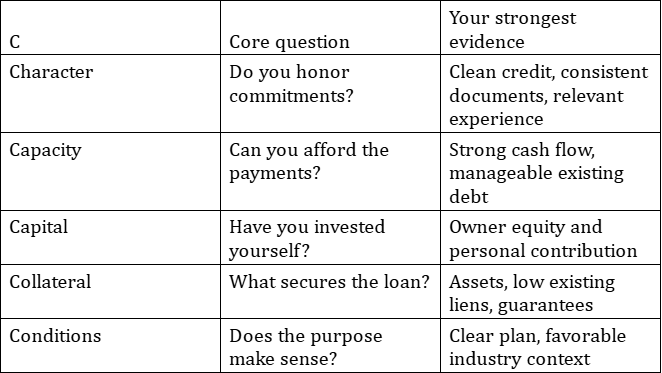
Few businesses are strong in every category. Underwriters weigh the C’s together, and strength in one area can offset modest weakness in another. A newer business with limited history, for example, might compensate with strong owner capital and collateral.
Small Details Underwriters Notice
Beyond the five big categories, experienced underwriters pick up on smaller signals that can tip a decision.
Overdrafts and negative balance days. Even a few in recent statements prompt questions about cash management.
Large unexplained transfers. Money moving between personal and business accounts without explanation can look like commingling or undisclosed debt.
Recent new debt. Financing taken in the last few weeks, especially if it does not appear on your debt schedule, raises concerns about transparency.
Rounded or inconsistent figures. Revenue stated as exactly $50,000 per month on an application, while statements show $41,000 to $46,000, suggests guesswork.
Slow or incomplete responses. How quickly and thoroughly you answer follow-up questions becomes part of the character assessment.
Addressing these proactively, with a sentence or two of explanation where needed, removes doubt before it forms.
Choosing the Right Lender for Your Profile
Different lenders emphasize different C’s. Traditional banks often weigh character, capital, and collateral heavily. Many online lenders focus primarily on capacity, judging recent bank deposits and revenue trends. Community lenders may give more weight to character and the owner’s plan.
That is why research matters before you apply. Understand which lenders tend to favor businesses with your particular strengths. Educational resources such as Business Loans IQ explain how lenders evaluate risk, and Business Loans Engine can help clarify eligibility criteria for different products. If capacity is your strongest C and you need short-term funding, Best Working Capital Loans describes products commonly underwritten on cash flow. Merchant Guidance offers insight into how financing decisions affect day-to-day operations.
Once you identify the lender whose priorities align best with your profile, apply there and only there. Submitting applications to many lenders at once undermines the very first C. Underwriters see recent inquiries on your credit report, and a cluster of them can make an otherwise solid applicant look desperate or overextended. Multiple hard inquiries can also lower your credit score, weakening your profile across every lender at once. A single, well-prepared application lets your strengths speak clearly. If that lender declines, ask which C held you back, strengthen it, and then approach the next best fit.
After the Decision
If you are approved, review the terms carefully and confirm they match your expectations. If you are declined, treat the decision as information. Ask the lender which factors weighed most heavily, request any adverse action notice you are entitled to, and build a plan to strengthen that area over the coming months.
Final Thoughts
Underwriters are not adversaries. They are professionals making decisions with incomplete information. The more clearly you answer their questions before they ask, the easier it is for them to say yes. Understand the Five C’s, assess your business honestly against each one, research lenders whose priorities match your strengths, and submit one complete, consistent application. Seen through the underwriter’s eyes, a well-prepared borrower stands out immediately.