
By: Bob Gleason
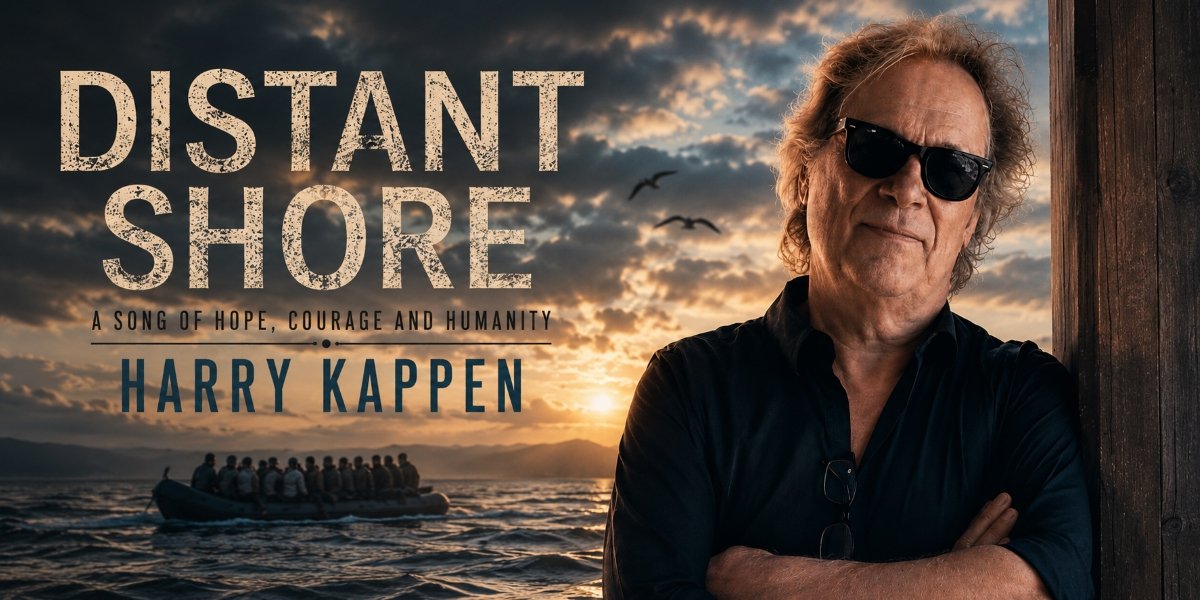
There are songs that exist chiefly as entertainment, and there are songs that attempt something more difficult: to make us feel the presence of people whom distance, politics, and habit have taught us not to see. Harry Kappen’s “Distant Shore” belongs to the second category. It is a song of conscience, but not a lecture; a song about suffering, but not one that traffics in suffering for its own effect. Its achievement lies in the manner with which it restores the individual human being to a story too often reduced to numbers.
Kappen wrote “Distant Shore” after hearing and reading repeated accounts of refugees crossing land and sea under inhumane conditions. The origin of the song is tied to his own relocation from the Netherlands to Mexico, but its meaning depends upon his recognition that the comparison ends there. He crossed by choice. Others leave because war, poverty, violence, or desperation have made home untenable. The moral force of the song begins in that distinction.
It is easy for a songwriter to confuse empathy with appropriation. Kappen avoids that error. He does not claim to know everything about the refugee experience, nor does he turn himself into the central character. Instead, he imagines the concrete details of departure: one small bag, one final look, a truck crowded with forty people, someone praying, someone fainting. In those details, the enormity of displacement becomes understandable.
The opening line is especially powerful: “I kiss the door I can’t replace.” That is the kind of image that tells us more than a page of explanation. A door is ordinary until it is the last thing connecting a person to the life they knew. The gesture is tender, but it is also final. Kappen understands that exile begins not at a border, but at the moment when familiar objects become memories.
Musically, “Distant Shore” is constructed with restraint. Kappen wrote, played, sang, and produced the track himself, yet the recording never feels like a demonstration of his abilities. That is important. Multi-instrumental records often suffer from the absence of resistance; nobody is present to tell the artist when enough is enough. Here, Kappen appears to have supplied his own discipline.
The mellotron gives the song much of its atmosphere. Kappen has acknowledged the influence of David Bowie’s “Space Oddity,” and the connection is audible in the sense of isolation that surrounds the arrangement. But this is not merely a stylistic borrowing. Bowie imagined a man separated from Earth by space. Kappen brings that loneliness back to the ground and the sea, where it becomes immediate and physical.
The keyboards hover like weather on the horizon. The rhythm maintains forward movement without providing comfort. The guitar passages do not announce themselves as heroic; they sound more like releases of pressure. Everything in the arrangement seems designed to place the listener inside an uncertain journey.
The chorus asks, “Where is that distant shore?” The question is simple, but its simplicity is deceptive. The shore is safety, certainly, but it is also dignity, permanence, opportunity, and the hope of not disappearing unnoticed. Kappen does not answer the question because the people whose lives inspired the song are not guaranteed an answer.
That refusal of easy resolution is one of the record’s virtues. Too many songs about serious subjects insist on lifting the listener toward redemption in the final chorus. “Distant Shore” does not offer comfort it has not earned. It allows hope to remain fragile.
Kappen’s vocal performance is measured and humane. He does not oversing, and he does not dramatize the lyrics beyond what the words can support. His voice carries concern, weariness, and a kind of moral attentiveness. He sounds less like a performer portraying suffering than a witness attempting not to turn away from it.
That quality may be connected to Kappen’s long career in music therapy and youth care. For more than two decades, he worked with people for whom music was not simply art or entertainment, but a means of connection. The best therapists learn to listen without taking possession of another person’s story. “Distant Shore” displays a similar instinct.
The track comes from After the Crossing, the first album Kappen recorded after moving to Mexico. That relocation appears to have widened rather than narrowed his perspective. He could have written an album centered entirely upon personal reinvention. Instead, one of its strongest songs considers the vastly more dangerous crossings undertaken by others.
There is a larger point here about what serious popular music can still accomplish. A song cannot change immigration policy, stop a war, or guarantee safe passage across a sea. But it can interrupt indifference. It can convert a statistic into a face, a doorway, a prayer, or a wave rising like a wall.
“Distant Shore” does precisely that.
Its power does not come from volume or novelty. It comes from attention—from one artist looking at a brutal reality and refusing to simplify it. Harry Kappen has made a song that is musically assured, emotionally honest, and morally awake.
At a time when distraction is one of the culture’s most abundant products, that attentiveness is no small achievement.